

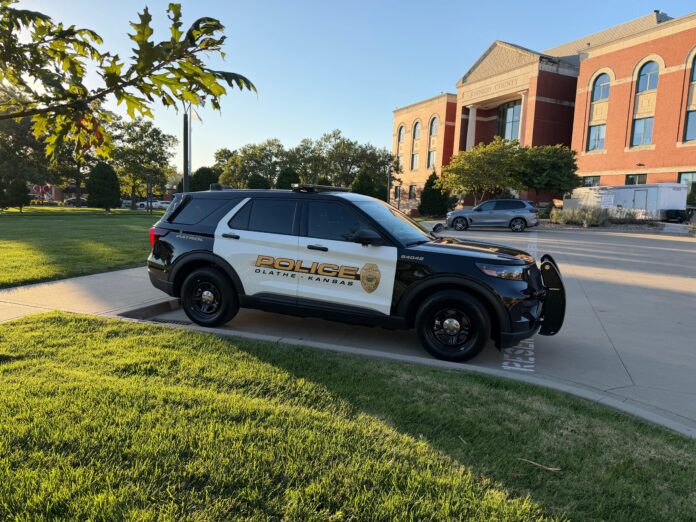
If you see police, firefighters or paramedics working an emergency in Olathe and stop to watch or record, there is a new rule you should know about.
Under certain circumstances, remaining within 25 feet of a first responder after being told to move back can result in a criminal charge.
The Olathe City Council voted this week to add Kansas’ new “Halo Act” to the city’s public offense code. The state law itself already took effect July 1, so Olathe did not create the 25-foot rule. Adding it to the city code means violations can now be handled locally through Olathe Municipal Court.
But there is an important distinction: the law does not simply make it illegal to stand within 25 feet of every police officer, firefighter or paramedic.
For someone to violate the law, several things must happen. The first responder must be performing official duties, the person must be within 25 feet, and a first responder must give a verbal or visual warning to move back because separation is reasonably believed necessary for the safety of a person or property.
The person must then remain too close in a way that distracts the first responder from doing the job or increases concern that someone could be physically harmed or property could be damaged.
In other words, simply walking past an officer on the sidewalk is not automatically a crime. Neither is standing nearby and watching police activity.
The warning to move back — and what happens after that warning — matters.
That raises an obvious question for anyone who has ever pulled out a phone to record something happening in public:
Can you still record police?
Yes. The new law does not prohibit people from recording law enforcement activity.
But if an officer or other first responder tells someone to back up because of a safety concern, that person may need to move at least 25 feet away and continue recording from there.
That is also where some of the controversy surrounding the law begins.
During discussion of the measure, Olathe councilmembers raised questions about how the rule might work in less clear-cut situations. For example, what happens if someone is standing in their own front yard while an officer is conducting a traffic stop less than 25 feet away?
Questions have also been raised about whether a mandatory 25-foot distance could interfere with a person’s ability to observe or record police activity.
Supporters of the law argue that police officers, firefighters and paramedics need enough room to safely do their jobs without someone crowding, distracting or interfering with them during an emergency.
Critics worry the law could be interpreted too broadly and potentially discourage people from legally documenting police activity.
The consequences can also be significant.
Unlawful approach of a first responder is a Class B person misdemeanor under Kansas law, meaning a violation can potentially carry a fine and jail time.
Federal law enforcement activity has added another wrinkle to the discussion. Federal officers are included in the law’s definition of first responders, although enforcement of the Kansas 25-foot boundary is limited to state and local law enforcement officers.
Olathe Police Chief Mike Butaud told the City Council that federal officers would need involvement from Olathe Police if they wanted someone prosecuted under the city’s ordinance. He also said he had previously declined one such request.
So what does all of this mean for the average Olathe resident?
If you come across an arrest, traffic stop, fire, medical emergency or other police activity, you can still watch and you can still record.
But if a first responder tells you to move back because of a safety concern, ignoring that direction while remaining within 25 feet could now carry legal consequences.
The larger debate over where public safety ends and the public’s right to observe government begins may continue.
For now, though, the 25-foot Halo Act is Kansas law — and it is now part of Olathe’s city code as well.
FILE VIDEO: Olathe police officers make an arrest across from Culver’s in Olathe. The arrest shown is unrelated to the Halo Act or the new 25-foot rule.


 Something Different Media Group
