

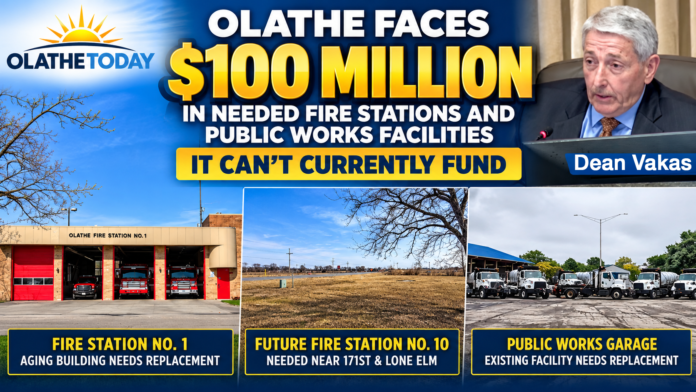
OLATHE, Kan. — Olathe is facing an estimated $100 million in major building projects that city officials say are needed but cannot currently be funded, including two fire stations and a replacement Public Works garage. The financial challenge emerged during Tuesday night’s City Council meeting, where a discussion about repairing an aging fire station expanded into a broader debate over how Olathe will maintain its existing facilities while keeping up with growth in the southern part of the city.
Mayor Pro Tem Dean Vakas put a dollar figure on the problem during the Oct. 20 meeting, estimating that the three facilities could collectively cost approximately $100 million. The figure was his estimate rather than an itemized construction budget, but it illustrated the difficult choices the city faces as elected officials prepare for additional financial constraints in 2027 and beyond.
“Collectively, those three buildings probably represents about $100 million that we just don’t have available at this stage,” Vakas told fellow councilmembers.
Vakas said the city has already tightened its spending and developed what he considers a responsible 2027 budget, but acknowledged that maintaining essential facilities will eventually require additional revenue.
“As this year unfolds and we consider what 2028 and beyond looks like, we will certainly have to look for other sources of revenue to be able to fund this additional infrastructure that we know we ultimately need,” he said.
The discussion followed the council’s unanimous approval of $2.21 million in critical structural repairs at Fire Station No. 1, a 43-year-old facility at 505 E. Old 56 Highway. The station has experienced significant foundation settlement, shifting walls, cracks between floors and walls, and persistent heating and cooling problems. Fire Chief Jeff DeGraffenreid told councilmembers that the building has deteriorated to the point that snow can enter through gaps created by structural movement, and portions of concrete block walls have required attention to prevent falling material from becoming a safety hazard.
Although the repairs are expected to extend the station’s useful life, they do not eliminate the need for a replacement. The facility opened in 1983 and no longer accommodates modern firefighting operations as efficiently as needed. Larger apparatus, specialized equipment and changing staffing requirements have placed additional pressure on a building originally designed more than four decades ago. Ten firefighters work 24-hour shifts at the station, which provides emergency coverage extending into southern Olathe.
The city began planning a replacement several years ago. In November 2023, councilmembers authorized $2.89 million for design and planning work on a new station, then part of a $20 million project. By 2024, the estimated total project cost had increased to approximately $26.9 million. Plans called for a larger, dual-company station on city-owned property at the Public Safety Campus, where the existing animal shelter is located.
The replacement was originally expected to move into construction by late 2025, but the city subsequently removed the project from its funded Capital Improvement Plan as budget pressures increased. The project also depended on relocating the animal shelter, another expensive undertaking that has experienced its own funding and scheduling changes. Although preliminary design work has been completed, no new construction date for Fire Station No. 1 has been established.
During Tuesday’s meeting, several councilmembers questioned how long the latest $2.21 million investment would keep the existing station operating. DeGraffenreid said he could not provide a definite answer until engineers and contractors complete a more detailed evaluation of the needed repairs. He emphasized that the improvements would address critical structural conditions, not modernize the entire building or provide the additional space the department needs.
That leaves the city spending millions to maintain a station it still intends to replace.
The second major fire-station need discussed Tuesday involves an entirely different challenge: Olathe’s continued expansion southward. The Fire Department has identified a future Fire Station No. 10 near 171st Street and Lone Elm Road, an area that would help improve emergency coverage along the growing 175th Street corridor between U.S. 169 and Interstate 35.
Unlike Fire Station No. 1, which requires replacement because of deteriorating conditions, Fire Station No. 10 would be an additional facility serving areas where residential, commercial and industrial development continues to expand. New subdivisions and employment centers are increasing the need for emergency services, particularly in the city’s southwestern areas, where fire apparatus must currently travel from existing stations.
DeGraffenreid acknowledged that Olathe’s southwestern growth area presents challenges for the department. He described Station No. 10 as the next station planned but said it remains outside the funded portion of the city’s Capital Improvement Plan.
The question of which station should come first prompted a difficult exchange. Councilmember LeEtta Felter asked whether rebuilding Fire Station No. 1 or constructing Fire Station No. 10 should receive priority after the immediate structural repairs are completed.
DeGraffenreid said the department must provide safe working conditions for firefighters already serving the community, while recognizing that a growing city also needs emergency coverage in newly developing neighborhoods. Replacing an aging station and adding one in an underserved growth area address different needs, and delaying either project carries consequences.
Councilmember Matt Schoonover raised another possibility for funding Fire Station No. 10. Because the proposed station could also benefit Johnson County and nearby communities, including Gardner and Spring Hill, Schoonover suggested exploring whether those jurisdictions might contribute toward its construction and staffing.
The communities already have mutual-aid relationships allowing fire departments to assist one another during emergencies. DeGraffenreid said those arrangements are valuable and help provide coordinated service across jurisdictional boundaries, but acknowledged that conversations about sharing the cost of a new station could be worthwhile.
No agreement for outside funding has been announced, and there is no indication that neighboring governments have committed money toward the proposed facility.
The third major expense mentioned by Vakas is a replacement for Olathe’s Public Works garage. Although the garage received less discussion than the fire stations, Vakas made clear that he considers it another facility the city ultimately must replace.
Public Works facilities support the crews, equipment and maintenance operations responsible for keeping the city’s streets and other infrastructure functioning. Vehicles, heavy equipment and maintenance operations require facilities that can accommodate modern machinery and the demands of a growing city.
“If you go to the public works garage, we need a new one. There’s no question about it,” Vakas said.
The council did not present a detailed construction estimate, architectural plan or timetable for replacing the Public Works garage during Tuesday’s discussion. That makes it difficult to determine how much of Vakas’ $100 million estimate applies to the garage compared with the two fire-station projects. The Public Works garage discussed Tuesday is also separate from the new City Hall parking garage being constructed downtown.
The conversation comes just weeks after Olathe approved its $657.6 million budget for 2027 and a separate five-year Capital Improvement Plan totaling approximately $757.4 million. Those figures represent spending across numerous city funds and projects, not money available for any proposed facility. Much of the capital program is already committed to specific street improvements, utilities, public buildings and other infrastructure.
City officials have spent months warning that operating expenses are increasing faster than some of the city’s major revenue sources. Personnel costs, health insurance, construction inflation and the expense of maintaining existing infrastructure have complicated efforts to balance the budget. The 2027 spending plan includes a freeze on 22 General Fund positions, while previously frozen positions remain unfilled.
Olathe maintained its property tax rate at approximately 23.3 mills for 2027, although the city expects to collect more property tax revenue because of changes in property valuations and continued development. At the same time, officials have reduced or postponed several capital projects to bring planned spending more closely in line with available resources.
MAYOR BACON DEFENDS CITY’S FIRE DEPARTMENT INVESTMENTS
Mayor John Bacon defended the city’s recent investments in public safety, pointing to the construction of Fire Stations No. 8 and No. 9, a new fire training facility, the planned replacement of Station No. 4 and improvements to existing stations.
Bacon disagreed with suggestions that the city had neglected its fire department, arguing that Olathe has continued investing in facilities while managing competing financial priorities. He characterized the problems at Fire Station No. 1 as part of the challenge of maintaining aging buildings and said he did not consider the situation an immediate emergency, although repairs are necessary.
“I would just remind everyone that we have invested a lot in our fire department over the last five, six years,” Bacon said.
He noted that the city opened Fire Station No. 8 several years ago, recently opened Station No. 9 and is moving ahead with the replacement of Fire Station No. 4 near Santa Fe Street and Mur-Len Road. The Station No. 4 project carries a separate $16.5 million budget. Bacon also cited renovations and repairs at other stations as evidence of the city’s ongoing commitment to fire protection.
“I really don’t think that this is an emergency at this point, but it’s something that we have to do,” Bacon said of the conditions at Fire Station No. 1.
His comments offered a different perspective from Councilmember Schoonover, who had earlier called the deteriorating condition of Station No. 1 embarrassing and questioned how the city allowed the facility to reach that point.
Despite their differing assessments of the city’s past investments, councilmembers unanimously approved the $2.21 million repair project.
The possibility of creating a dedicated public safety sales tax also surfaced during the discussion. Felter asked how other growing communities pay for new fire stations, and DeGraffenreid explained that some jurisdictions use public safety sales taxes to provide an ongoing source of revenue for major needs.
He said such an arrangement could be considered in Olathe as a future policy decision, but the discussion did not amount to a formal tax proposal. The council did not introduce or approve a new sales tax Tuesday, and no specific tax rate, revenue estimate or implementation plan was presented.
A dedicated funding source could provide another way to finance public safety infrastructure, but it would also require councilmembers to evaluate the cost to residents and businesses, competing priorities and any applicable legal requirements. Other possibilities discussed included revisiting capital spending priorities and seeking financial partnerships with neighboring jurisdictions.
For residents, the consequences of these decisions may not be immediately visible. Fire Station No. 1 remains operational, firefighters continue responding throughout the city, and Public Works employees continue maintaining roads and infrastructure. But the city’s list of facilities needing replacement is growing, even as officials attempt to limit spending.
Fire Station No. 1 illustrates the challenge particularly clearly. The council has authorized more than $2 million to address urgent problems in a building that officials still expect to replace. Meanwhile, the proposed Station No. 10 remains unfunded despite continued development in southern Olathe, and the Public Works garage has no publicly established replacement schedule from Tuesday’s discussion.
Vakas said the city will have to confront those needs as it begins planning future budgets rather than assuming the projects can be postponed indefinitely.
For now, Olathe has identified approximately $100 million in major facility needs without a clear way to pay for them all. The question facing the City Council is not simply which buildings should be replaced, but how a growing city will finance the infrastructure required to maintain the level of service residents expect.


 Something Different Media Group
