

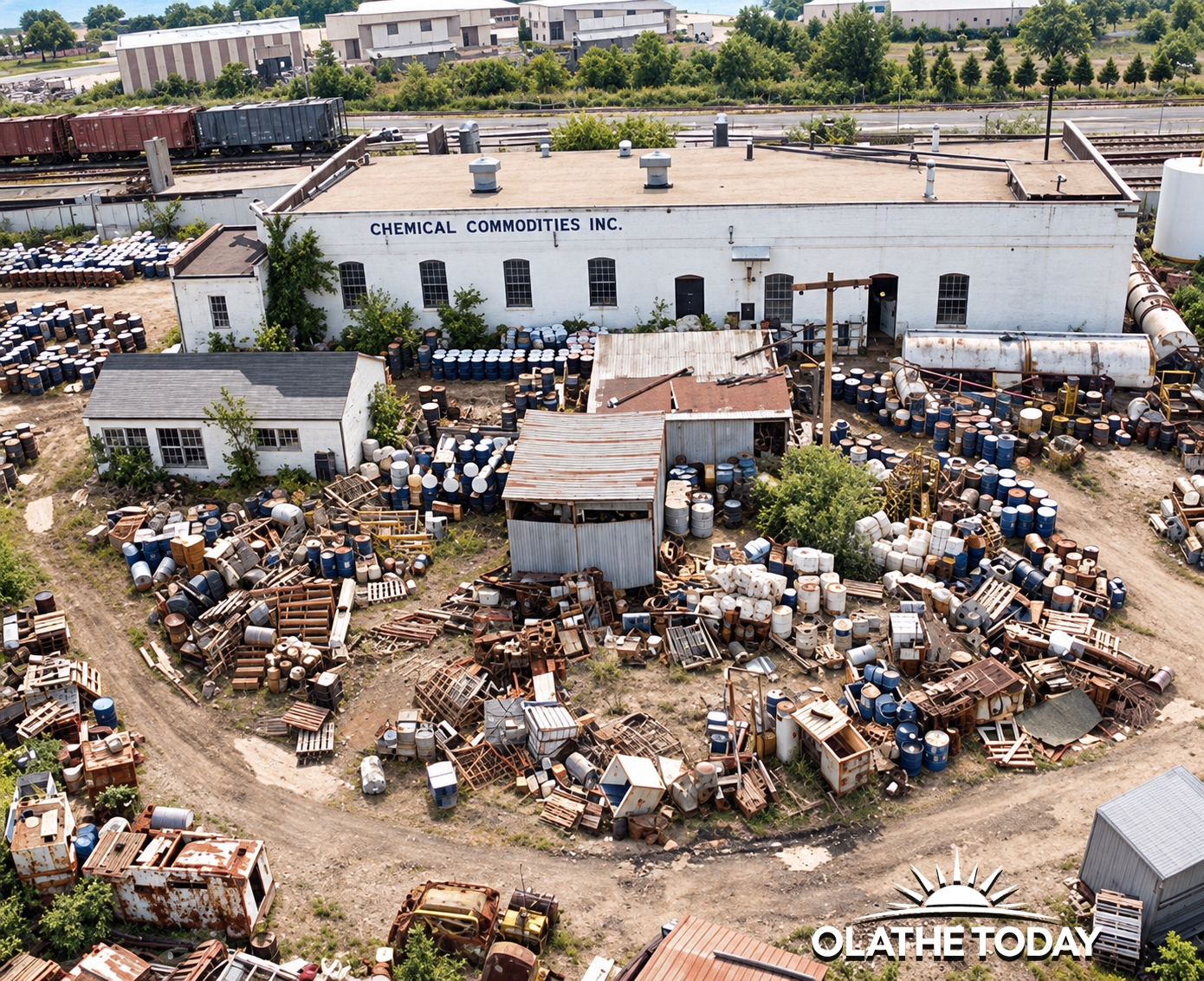
Decades after Chemical Commodities closed, hazardous chemicals remain beneath an Olathe neighborhood. Federal officials are seeking a new cleanup plan, while historical newspaper accounts reveal how the problems began and why the company faced criminal penalties more than 35 years ago.
OLATHE, Kan. — More than three decades after federal authorities began cleaning up one of Olathe’s most notorious industrial properties, the Environmental Protection Agency has concluded that the cleanup is not adequately protecting human health and the environment.
The former Chemical Commodities Inc. property at 320 S. Blake St., now known as Pollinator Prairie, has undergone extensive environmental restoration. The abandoned buildings and chemical drums are gone, contaminated soil has been removed or covered, and the property has become a garden filled with native plants, butterflies and walking paths.
But beneath that transformation, a serious problem remains.
Chemical contamination continues to move through groundwater underneath surrounding residential neighborhoods. The pollutants can release vapors that enter homes through foundations, cracks and other openings.
The EPA’s latest five-year review, signed Sept. 24, determined that the existing cleanup is “not currently protective of human health and the environment.”
Federal officials have identified 22 homes with contamination above EPA vapor-intrusion action levels, prompting new or repaired mitigation systems. They are also seeking permission to test dozens of additional homes.
Now, the agency says the corporations and federal entities responsible for the contamination will need to develop a different long-term solution.
The developments represent another chapter in a story that stretches from Olathe’s industrial past through criminal court proceedings in the early 1990s, a multimillion-dollar cleanup and years of efforts to protect the surrounding community.
EPA finds contamination is moving beneath neighborhood
The September review identifies two interconnected problems.
First, contamination remaining in the soil beneath the protective cap at the former chemical facility continues to affect the groundwater.
Second, polluted groundwater has traveled beneath neighboring properties, particularly west of the former facility.
The EPA says concentrations of volatile organic compounds, commonly called VOCs, have not declined as expected and remain above cleanup goals.
These chemicals can evaporate from contaminated groundwater and move through soil as gases. When those gases enter buildings, the process is called vapor intrusion.
One of the principal chemicals involved is trichloroethylene, or TCE, an industrial solvent historically used to remove grease from metal parts.
Exposure to TCE can pose serious health risks, including effects on the liver, kidneys and nervous system, and an increased risk of certain cancers. The level of risk depends on the concentration, duration and route of exposure.
The EPA’s determination does not mean every home near Pollinator Prairie has unsafe indoor air. Individual conditions vary, and testing is necessary to determine whether a particular property is affected.
The contamination also does not mean Olathe’s municipal drinking water is unsafe. Federal officials have specifically stated that the city’s public drinking water supply is not affected by the site.
More than 150 homes contacted, but testing remains incomplete
According to the EPA’s current site information, the agency contacted 156 homes during its 2025-26 testing effort and obtained access to 107.
Twenty-two homes had results above the agency’s vapor-intrusion action levels.
The EPA reports that its response work has included 15 critical repairs to existing vapor mitigation systems and nine new system installations. The agency also reports upgrading 25 systems with additional protections, including audible alarms to alert residents when equipment malfunctions.
Some homes already had protection systems installed years ago. Others were found to need systems for the first time.
Those systems generally use fans and piping to draw contaminated gases from beneath a building and discharge them outdoors before the vapors can accumulate inside.
The systems can be effective when properly designed, operated and maintained. But they do not eliminate the groundwater contamination responsible for the problem.
Approximately 49 homes remained without access for the latest round of testing, based on the EPA’s figures.
That leaves a significant unanswered question: How many additional homes might require protection if federal officials can complete testing throughout the affected area?
EPA Region 7 Administrator Jim Macy told KSHB 41 News that access to homes is essential to determining the extent of the problem and protecting residents.
The EPA provides testing and necessary mitigation installations at no cost to participating homeowners.
Earlier EPA records show serious contamination before the latest review
An examination of a federal emergency-action memorandum from January 2025 reveals that the EPA had already documented alarming contamination levels before issuing its September 2026 review.
During testing in late 2024, investigators found TCE concentrations exceeding 200 micrograms per cubic meter in living areas of a residential duplex in the neighborhood.
An attached garage at the property recorded a concentration of 860 micrograms per cubic meter during November 2024 sampling.
For comparison, the EPA’s site-specific indoor-air action level for TCE listed in the memorandum is 2 micrograms per cubic meter.
The garage measurement was 430 times that action level. Measurements in residential living areas were also far above the threshold.
The EPA reported that the property was vacant during one of the sampling events and that investigators had ruled out certain recent chemical activities that might otherwise have influenced the results.
The agency subsequently developed mitigation measures addressing vapors beneath the building and potential pathways involving drain lines.
These measurements concern specific buildings and sampling dates. They should not be interpreted as typical readings throughout the surrounding neighborhood or as evidence that current conditions at those buildings are unchanged.
The same federal memorandum describes another serious incident in July 2018.
After elevated TCE levels were found at a residence, the Agency for Toxic Substances and Disease Registry recommended that the tenants leave temporarily.
EPA investigators discovered that the home’s vapor mitigation system was not operating.
Subsequent sampling measured TCE concentrations of 33 micrograms per cubic meter in a bedroom and 22 in a living room.
The EPA repaired the system and provided assistance with certain relocation and living expenses while the problem was addressed.
The incidents demonstrate why the condition and maintenance of residential ventilation systems are critical, even years after they were installed.
A chemical business in the middle of Olathe
To understand why the contamination remains, it is necessary to look back at what operated on the property for nearly four decades.
Chemical Commodities Inc. operated from 1951 until 1989 on approximately 1.5 acres along South Blake Street, near South Keeler Street and not far from Santa Fe Street.
The company purchased, stored, repackaged, recycled and resold chemicals, including surplus and off-specification materials obtained from other companies and government agencies.
Chemicals were held in barrels, drums, cylinders, bottles and aboveground and underground storage tanks.
According to EPA historical records, inadequate handling and storage practices resulted in spills, leaks and releases of hazardous materials into the surrounding environment.
Residents complained about chemical odors, contaminated runoff and fires. The EPA has documented reports of explosions and fires during the 1960s and 1970s.
Federal investigators became involved during the early 1980s.
By 1985, the EPA had entered into an agreement requiring the company to address runoff, control dust and investigate underground storage tanks.
In 1986, three underground tanks were removed. Investigators later determined the tanks had leaked chemicals, including trichloroethylene and related solvents.
Groundwater monitoring conducted in the late 1980s confirmed elevated levels of industrial solvents.
The investigation revealed a contamination problem that could not be solved simply by closing the business or removing the barrels.
Criminal charges, a $500,000 fine and a cleanup estimated at $5 million
Historic Kansas City Star newspaper articles from 1990 and 1991, reviewed alongside federal enforcement documents, show that the Chemical Commodities controversy became a significant criminal and environmental enforcement case.
In January 1990, Chemical Commodities Inc. pleaded guilty to unlawfully disposing of hazardous waste.
The criminal case involved the disposal of methyl bromide, a toxic chemical.
An EPA enforcement report states that in 1988, company president and owner Jerald Gershon directed employees to destroy approximately 40,000 small glass ampules containing methyl bromide.
According to the federal account, employees crushed the ampules using a grinder, allowing the chemical to escape as gas. The broken glass was subsequently placed in a local landfill.
That incident was a separate hazardous-waste violation and should not be confused with the TCE groundwater contamination that remains the central concern today.
In May 1990, a federal court sentenced the corporation to five years of probation and imposed requirements intended to bring its operations to an end and compel cleanup work.
A $500,000 fine was initially suspended, subject to the company’s compliance with the court’s conditions.
The EPA later accused Chemical Commodities of failing to meet its obligations.
In an Oct. 12, 1990, article, The Kansas City Star reported that the cleanup was expected to cost approximately $5 million.
The newspaper’s headline was “Cleanup of site to cost $5 million.”
At the time, authorities were struggling with the expensive task of dealing with hazardous chemicals, contaminated soil and polluted groundwater.
The Star returned to the case Aug. 15, 1991, with an article headlined “Judge orders chemical company to pay $500,000 fine.”
The report described federal court action after the company failed to meet conditions of its criminal plea agreement.
EPA records from 1990 also reveal that the agency rejected a proposal from the company to transfer its properties to the federal government as a substitute for complying with required cleanup obligations.
Chemical Commodities and its owner subsequently entered bankruptcy proceedings, complicating efforts to recover cleanup costs.
The criminal guilty plea was entered by the corporation. The historical records should not be interpreted as establishing that Gershon was personally convicted in that corporate case.
The original $5 million estimate was a projection made in 1990, not an accounting of the total amount eventually spent on the decades-long cleanup.
What became of the original cleanup?
Federal authorities began removing hazardous materials and contaminated soil in 1989, with major early cleanup work continuing through 1991.
A groundwater interceptor trench was part of the early effort to capture polluted water and limit its movement away from the property. Contemporary newspaper coverage in March 1991 included diagrams explaining the planned groundwater controls.
But the contamination proved persistent.
In 1994, the EPA added Chemical Commodities to the National Priorities List, the federal program commonly known as Superfund.
Investigations continued through the 1990s and early 2000s.
In 2003, the EPA demolished the deteriorating former warehouse and removed additional contaminated soil.
Between 2003 and 2007, vapor mitigation systems were installed in 51 neighboring homes vulnerable to contamination entering indoor air.
A comprehensive cleanup plan was formally selected in September 2005. It included treatment of contaminated groundwater, ongoing monitoring, natural breakdown of chemicals over time and protective measures for nearby homes.
Additional construction and treatment work was undertaken in the following years.
By 2011, major components of the remedy were in place, and the EPA recorded construction completion in January 2012.
The former industrial property was transformed into Pollinator Prairie, which opened to the community in 2012.
Boeing, which took a leading role among the parties involved in the cleanup, worked with the EPA, community representatives and conservation organizations to turn the site into a habitat for bees, butterflies, birds and native plants.
The property became an example of how a former industrial site could be reused.
But the completion of construction was never the same as eliminating every contaminant in the groundwater.
The 2026 findings demonstrate that distinction.
The EPA had already warned the groundwater cleanup was not working
The latest conclusions did not emerge without warning.
In its 2021 five-year review, the EPA raised concerns about the performance of the groundwater remedy.
The agency concluded that the groundwater treatment did not appear to be functioning as intended.
At that time, residential vapor mitigation systems provided short-term protection, but the underlying contamination remained a concern.
The original groundwater cleanup had been expected to take approximately 100 years, but newer estimates indicate the process could require hundreds of years.
One difficulty involves chemicals that have penetrated underground rock formations. Contaminants can slowly move back out of the rock and into groundwater, making it difficult to achieve lasting reductions.
The EPA’s September 2026 public notice says concentrations of VOCs in the neighborhood have not decreased over time as required by the cleanup goals.
The agency also identified new vapor-intrusion concerns west of the property.
In other words, years of treatment and monitoring have not brought the underground contamination under adequate control.
Twelve companies and federal entities face a new cleanup process
The EPA is now pursuing another major step: development of a revised cleanup plan involving the parties identified as responsible for the site.
In an interview EPA Region 7 Administrator Jim Macy said the agency does not consider the existing remedy effective because contamination levels are not falling as expected and the affected area appears to be expanding.
The EPA is looking to 12 corporate and government entities associated with chemicals sent to the former facility.
The entities identified include Ashland Inc., Boeing Co., CertainTeed Corp., Hallmark Cards Inc., Honeywell Federal Manufacturing & Technologies LLC, Mallinckrodt Inc. and BNSF Railway.
The group also includes Alliant Techsystems Inc., as successor to Cordant Technologies and Hercules; Lucent Technologies Inc., as successor to Western Electric and AT&T Technologies; the Defense Reutilization and Marketing Service; the U.S. Department of Energy; and the U.S. Air Force.
These are potentially responsible parties under the federal Superfund process. Their inclusion does not mean that each operated the Olathe facility or was individually convicted of wrongdoing.
Macy said that the parties would be responsible for a new cleanup plan, a new federal Record of Decision and a new public participation process.
A Record of Decision is the EPA’s formal document selecting a cleanup remedy after environmental investigation and consideration of alternatives.
The replacement approach has not yet been finalized.
Additional groundwater monitoring wells are expected, and the EPA plans to evaluate other ways of addressing contamination in the soil and groundwater.
A study of additional cleanup options is expected by October 2028.
That is a target for evaluating alternatives, not a projected date when the contamination will be eliminated.
Another question: How long can the protection systems be maintained?
The January 2025 emergency-action memorandum also provides a look at the financial challenges involved in maintaining the residential protection program.
According to that record, the EPA had been spending approximately $150,000 annually to operate and maintain vapor mitigation systems.
The document reported a balance of $559,906 in a special account used to fund the program and projected that the account could be exhausted by fiscal year 2027 if spending continued.
The same memorandum estimated the total cost of a new time-critical response at approximately $917,410, including federal direct and indirect costs.
That response was intended to support sampling, installation and repair of mitigation equipment, and temporary use of air purifiers where needed.
Those figures are planning estimates from the 2025 document. They do not establish the account’s current balance or the amount ultimately spent.
The EPA has legal mechanisms to seek reimbursement and compel cleanup work from responsible parties, and Macy has emphasized that homeowners are not being asked to pay for the remediation.
Nevertheless, the records illustrate the long-term financial demands of keeping homes protected while groundwater contamination remains unresolved.
Residents remember what the property looked like
For longtime Olathe residents, the latest findings have revived memories of the years when Chemical Commodities operated in the neighborhood.
Residents described seeing chemical runoff, smelling unusual odors and watching the property deteriorate.
Hazel and Charles Forgey, who have lived near the property since the 1960s, said they had kept decades of correspondence from the EPA.
Hazel Forgey recalled seeing unusual green and orange water flowing along the street.
Another resident, Greg Divine, said that he remembered the industrial site from his childhood and remained concerned about the contamination.
The residents’ accounts offer an important reminder that the property was not always the landscaped prairie visitors see today.
For families who lived nearby, the industrial operations and subsequent cleanup were part of everyday life.
Olathe officials question communication about the problem
The renewed attention has also prompted concerns from Olathe city officials.
City Council member Jeff Creighton expressed frustration that the community is still confronting contamination that originated decades ago.
Creighton said the city needs to receive more frequent information about the results of environmental testing.
He also emphasized that federal authorities have primary responsibility for the cleanup.
Ward 1 Council member Robyn Essex said in a statement that the health and safety of residents and protection of the environment remain city priorities.
She said the city is monitoring developments and expects more information about measures being taken to protect the neighborhood.
Officials have also stressed that Olathe continues to monitor the water it supplies to residents.
The EPA has confirmed that the public drinking water system is not contaminated by the former Chemical Commodities site.
What happens when a home changes owners?
Another issue receiving new attention is whether people purchasing homes near the Superfund site are adequately informed about the contamination.
Some residents said they learned about the history only after purchasing their properties.
Macy acknowledged that the EPA does not automatically receive notification when a home in the affected area changes ownership.
That can complicate efforts to maintain contact with residents, secure permission for testing and explain the importance of existing mitigation equipment.
Seller disclosure forms used in the Kansas City area address known hazardous conditions and environmental contamination. Sellers and their agents may have disclosure obligations when they know of such conditions.
But the EPA’s lack of an automatic ownership-change notification process raises a separate concern: whether new residents are consistently receiving current information directly from the agency.
A property’s proximity to the former facility does not, by itself, establish that its indoor air is contaminated.
Residents who are uncertain whether their home falls within the EPA’s assessment area are encouraged to contact the agency.
EPA plans December meeting as more work continues
The EPA has announced that it will hold a public meeting to discuss the latest review and the next steps for the site.
The agency is planning a community meeting for Dec. 1, although the time and location had not been announced as of Oct. 28.
In the meantime, federal officials are continuing to seek access to homes, inspect existing vapor mitigation systems and install or repair equipment where necessary.
The EPA has also said it needs to better determine how far the contaminated groundwater has moved and whether additional properties could be affected.
Residents who already have vapor mitigation systems should keep them operating and promptly report alarms, malfunctions or interruptions.
People who have not had their properties tested can contact EPA Region 7 to ask whether they are within the assessment area and arrange sampling if appropriate.
EPA Remedial Project Manager Stephanie Pfannenstiel can be reached at 913-551-7242 or pfannenstiel.stephanie@epa.gov.
Community Involvement Coordinator Shaylee Borcsani can be reached at 913-551-7713 or borcsani.shaylee@epa.gov.
The EPA’s official Chemical Commodities Superfund records are also available online and through the Olathe Indian Creek Library at 16100 W. 135th St.
A cleanup that is not yet finished
For decades, the story of Chemical Commodities seemed to have a progression toward a successful ending.
The dangerous chemical business closed. Criminal charges followed. Federal officials removed hazardous materials and demolished abandoned buildings. A modern cleanup system was installed, and the property eventually became a community prairie.
That progress was real.
But the latest EPA findings reveal that restoring the visible surface of the property has not resolved the contamination beneath the surrounding neighborhood.
The challenge now is not simply maintaining the prairie or monitoring old cleanup equipment.
It is determining how to stop the underground contamination from continuing to threaten homes and how to protect the people living above it.
More than 35 years after Chemical Commodities closed its doors, that work remains unfinished.

 Something Different Media Group
