


By David Miller
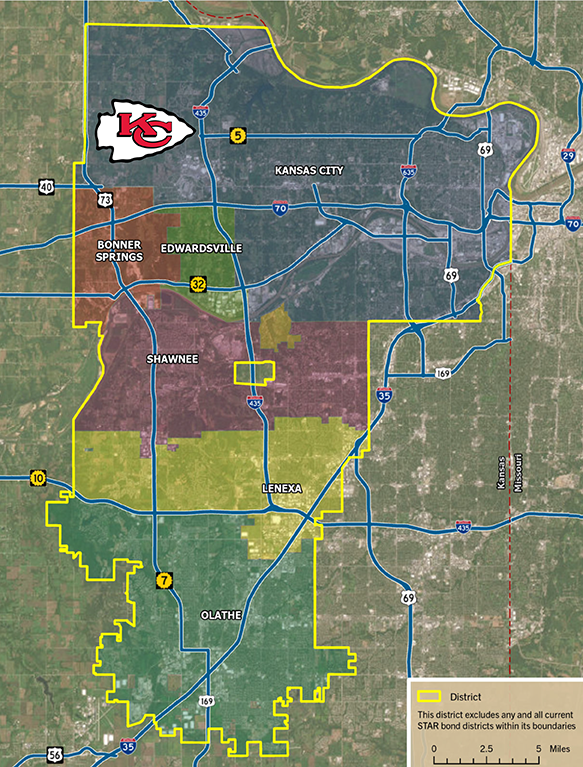
OLATHE, Kan. — Kansas has finalized the boundaries of the sprawling STAR Bond district that will help finance the Kansas City Chiefs’ move across the state line, drawing a district that reaches from Kansas City, Kansas, through portions of Wyandotte and Johnson counties and south into Olathe. The map answers one major question about the financing plan — where the state intends to capture sales-tax revenue — while raising others about why some communities were included, how the revenue baseline will be established and how much of the project ultimately will be supported with public money.
Lt. Gov. and Commerce Secretary David Toland published the final boundaries Oct. 13. The district includes portions of Kansas City, Kansas; Bonner Springs; Edwardsville; Shawnee; Lenexa; and Olathe. Kansas says the district will provide a broad revenue stream to help finance the Chiefs’ planned $3 billion domed stadium in Wyandotte County, the team’s new headquarters and training facility in Olathe and portions of the mixed-use development surrounding the two sites.
For Olathe, the news is not that the Chiefs are coming to the city. The Chiefs and Kansas announced that agreement in December 2025, and the Olathe City Council voted 7-0 in February to participate in the STAR Bond project. What is new is the final state map showing just how far beyond the stadium and headquarters sites Kansas intends the financing district to extend.
The Chiefs’ latest estimate puts the overall Kansas investment at approximately $4.5 billion, including the $3 billion stadium, a $300 million headquarters and practice facility in Olathe and $1.2 billion in private ancillary development around the two locations. The team says the stadium and Olathe facility are expected to open in 2031.
THE MAP EXTENDS WELL BEYOND THE CHIEFS’ TWO PROJECT SITES
The most striking feature of the final map is its size. The district covers a large portion of Wyandotte County before extending through Shawnee and Lenexa and into Olathe. At the same time, several Johnson County communities — including Overland Park, Leawood, Mission Hills, Merriam and Lake Quivira — remain outside the boundary.
Kansas has not provided a city-by-city explanation for why each of those communities was omitted. The Commerce Department said the district was designed around two goals: maximizing the economic impact of the Chiefs project and generating enough revenue to pay the bonds off as early as possible so those revenues can eventually return to the state and participating local communities.
The state has identified three specific exclusions that help explain some of the map’s unusual shape. Existing STAR Bond districts are excluded, along with the University of Kansas Medical Center complex and the area immediately surrounding it. Kansas also left out a predominantly vacant portion of Shawnee. Those exclusions explain some of the holes in the map, but the state’s announcement does not fully explain why entire communities such as Overland Park and Leawood fall outside the Chiefs district.
That distinction quickly became one of the questions raised by people examining the map. Some residents also asked whether Kansas will release a more detailed version showing exact streets and property boundaries, information that could become increasingly important to businesses trying to determine whether a particular location falls inside or outside the district.
THE MAP DOES NOT CREATE A NEW CHIEFS SALES TAX
Another source of confusion is what happens when someone makes a purchase inside the district. Being inside the STAR Bond boundary does not by itself add a special Chiefs sales tax or increase the sales-tax rate paid at the register.
Eric Fortner summed up the confusion in a question raised after the map was released: “Are they raising the sales tax or just taking it from the sales tax?”
The second description is closer to what the financing mechanism does. The existing tax rate is collected, but qualifying state sales-tax revenue from businesses within the district can be pledged toward repayment of the STAR Bonds.
That makes the financing more complicated than simply saying all sales taxes collected inside the yellow line will suddenly go to the Chiefs. They will not. But the size of the district matters because it establishes the geographic pool from which qualifying state revenue can be pledged toward the project.
A KEY QUESTION: WHAT WILL KANSAS USE AS THE BASELINE?
The release of the map has brought new attention to another important part of the calculation: the amount of revenue Kansas will treat as the existing base before determining what can be captured for the project.
John Murphy raised that question directly, asking: “What will be the baseline year?”
That is not a minor accounting detail. The baseline determines how much existing sales-tax revenue is treated as already occurring before the project and how much future growth can be captured for the bonds.
Other residents have questioned whether inflation will be considered, noting that sales-tax collections can increase simply because prices rise over time. Those questions go beyond what is shown on the map and will depend on the financial structure and base-year determination used as the project moves toward bond issuance.
The final district map settles the geographic question — where the revenue can come from — but not every financial question about how much revenue will ultimately be captured.
THE MAP REVIVES THE LARGER DEBATE OVER PUBLIC FINANCING
The boundaries have also renewed the broader debate over how much public support Kansas should provide for a privately owned NFL franchise.
Kansas officials have promoted the project as a major economic-development opportunity, saying the financing mechanisms were structured so there would be no new state tax and no negative impact on the existing state budget. The project is structured as a public-private partnership, with STAR Bonds and other state financing mechanisms supporting the public portion while the remaining costs are privately financed.
Some residents see the project as an opportunity to bring billions of dollars in investment, jobs and visitors to Kansas. Tim Mense, who said he lives within the district, said he is looking forward to the economic activity that could come with the project.
“I’m right in the middle of this,” Mense said. “Can’t wait for the economic boom coming my way.”
Others want more information before deciding whether the financing makes sense. Nolan Lewis, who described himself as a Chiefs fan, questioned how much the Hunt family and private investors will ultimately contribute and what Kansas receives in return for its public participation.
“If I’m missing something that is good for Kansas please let me know and I will support it,” Lewis said. “I would love to be educated on all the pros and cons of this project.”
That question goes beyond whether someone supports the Chiefs. It gets at the central financial issue surrounding the project: whether the new economic activity generated by the stadium, Olathe headquarters and surrounding developments will produce enough additional revenue and broader economic benefits to justify the public portion of the financing.
OLATHE’S LOCAL PLEDGE IS NOT THE SAME AS THE GIANT STATE MAP
For Olathe residents, perhaps the most important distinction is that the newly released state STAR Bond district is not the same thing as the smaller area from which Olathe has agreed to contribute local revenue.
When the Olathe City Council approved its participation in February, the city’s pledge was limited to certain property at the northwest corner of College Boulevard and Ridgeview Road, where the Chiefs plan to build their headquarters and training facility.
Olathe agreed that, for up to 30 years or until the applicable STAR Bonds are retired, certain new local revenues generated within that project area can be pledged toward repayment. Those include the city’s general sales and use tax that is not otherwise committed, Olathe’s applicable share of Johnson County sales-tax revenue and a portion of the city’s transient guest tax on lodging within the project area.
The city specifically excluded its voter-approved street maintenance sales tax and parks sales tax. Revenue generated outside the project area is also excluded from Olathe’s pledge.
The city has said it is not issuing general obligation debt backed by Olathe taxpayers and that the STAR Bonds will not constitute a debt or liability of the city.
That distinction matters because someone looking only at the newly released state map could reasonably assume that all Olathe taxes collected within the larger yellow boundary are being redirected to the Chiefs project. That is not what Olathe approved.
The state map establishes the much broader area from which Kansas can pledge state revenue, while Olathe’s local commitment is tied to the much smaller Chiefs development area near College and Ridgeview.
THE OLATHE HEADQUARTERS IS MOVING FURTHER INTO THE PLANNING STAGE
The Chiefs’ Olathe facility is expected to become the organization’s day-to-day football and business headquarters, housing players, coaches, scouts, executives and other employees.
The approximately $300 million project is planned on about 155 acres near College Boulevard and Ridgeview Road and will include indoor and outdoor practice facilities, football operations and administrative space.
The Chiefs selected Burns & McDonnell as owner’s representative for the project and later named Populous the lead design architect for the Olathe headquarters and training facility. Populous will also work on the master plan for the surrounding mixed-use development.
The Chiefs and Hunt Midwest have also created Two-Point Development, a joint venture that will oversee mixed-use development surrounding both the new stadium and the Olathe headquarters.
The Olathe site still must go through the city’s normal land-use, zoning and design-review processes, along with additional public meetings and City Council actions. The city has also said it expects to enter into a formal development agreement with the Chiefs for the Olathe portion of the project.
THE FINAL MAP ANSWERS ONE QUESTION — AND OPENS SEVERAL MORE
Kansas officials say the purpose of drawing such a broad STAR Bond district is to maximize the project’s economic impact and build a diversified revenue stream capable of retiring the bonds as quickly as possible. Once the debt is retired, the state says those revenues can again flow to Kansas and participating communities.
“Establishing the district boundaries moves us one step closer to building the Chiefs’ new state-of-the-art domed stadium in Kansas,” Toland said.
The boundaries do not answer every question about the deal. Kansas has not provided a city-by-city explanation for every community excluded from the district, the public announcement does not identify the state base-year revenue amount that will be used, and significant project-specific financial and development work remains before the stadium and Olathe headquarters are built.
What the map does provide is the clearest picture yet of the geographic reach of the financing strategy.
The Chiefs’ new Kansas home will consist of two primary project sites — the stadium in Wyandotte County and the headquarters in Olathe — but the state revenue district supporting the deal stretches across six cities and a much larger portion of the Kansas City metropolitan area.
For Olathe, that shifts the story beyond the already-settled question of whether the Chiefs plan to locate their headquarters here. The next questions are how the financing will work in practice, how much tax revenue ultimately will be committed to the bonds and whether the development produces the economic growth Kansas is counting on to pay them off.


 Something Different Media Group
