
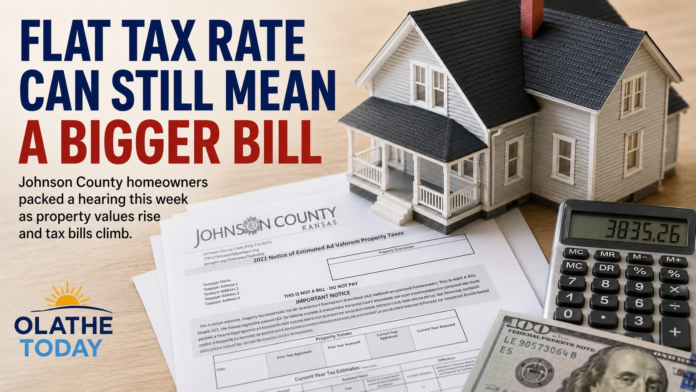
The words “flat tax rate” sound reassuring.
But for many Johnson County homeowners, a tax rate that barely changes can still produce a property tax bill that goes up — sometimes considerably — when the value of the home underneath it keeps rising.
That frustration filled the Olathe Conference Center this week, where about 175 people attended Johnson County’s public hearing on its proposed 2027 budget. Thirty-six residents spoke during the roughly two-hour hearing, with most asking county commissioners to do more to hold down property taxes.
The county is considering a budget of roughly $1.9 billion for next year. Its overall mill levy — the rate used to calculate property taxes — is expected to remain essentially unchanged at about 24.1 mills. But that doesn’t necessarily mean an unchanged tax bill. Johnson County’s assessed valuation is projected to grow about 5.1%, meaning the same tax rate can generate more money as property values increase.
That distinction was at the heart of much of Tuesday night’s frustration.
Several Olathe residents told commissioners that increases in home values may look good on paper, but homeowners can’t use that increased equity to pay the tax bill unless they actually sell their house.
Olathe resident Aaron Haffey told commissioners his overall property taxes have increased dramatically since 2012 and said he worries Johnson County could eventually become too expensive for his children to live here. Another Olathe resident, Tabitha Looper, described the strain increasing taxes have placed on her household after the death of her husband, a retired county employee.
County leaders say the picture is more complicated.
Officials say they have already found more than $15 million in savings through department consolidations, position reductions and other changes. Vacant positions are also being reviewed before they are automatically filled. County leaders argue that deeper reductions could begin affecting services residents expect, while drawing heavily from reserves could weaken the county’s financial position.
Those reserves are a sizeable part of the budget. Of the roughly $1.9 billion plan, about $1.38 billion represents expenditures, while approximately $533 million is budgeted in reserves. County officials also point to Johnson County’s Triple-A bond ratings, which help the county borrow money at favorable interest rates for major projects.
There is another reason the terminology can get confusing.
Kansas’ “revenue neutral rate” is the tax rate that would allow a local government to collect the same amount of property-tax revenue as the year before, after changes in total property valuation are considered. So a government can actually lower its mill levy and still collect more property-tax money if property values have risen enough.
That is what Johnson County proposes to do.
Commissioners voted 6-1 Tuesday to exceed the revenue-neutral rate, with Commissioner Michael Ashcraft casting the only dissenting vote. The vote does not yet formally adopt the 2027 budget.
The final vote is scheduled for Thursday, Sept. 3.
For homeowners, perhaps the most important thing to remember is that the Johnson County portion is only one piece of a property-tax bill. Cities, school districts, libraries, parks and other taxing jurisdictions can all have their own levies.
Still, the debate in Olathe this week illustrated something homeowners increasingly understand:
A tax rate can stay flat while the check you write gets bigger.
And with property values continuing to climb, that simple fact is becoming one of the biggest budget issues facing Johnson County.


 Something Different Media Group
