

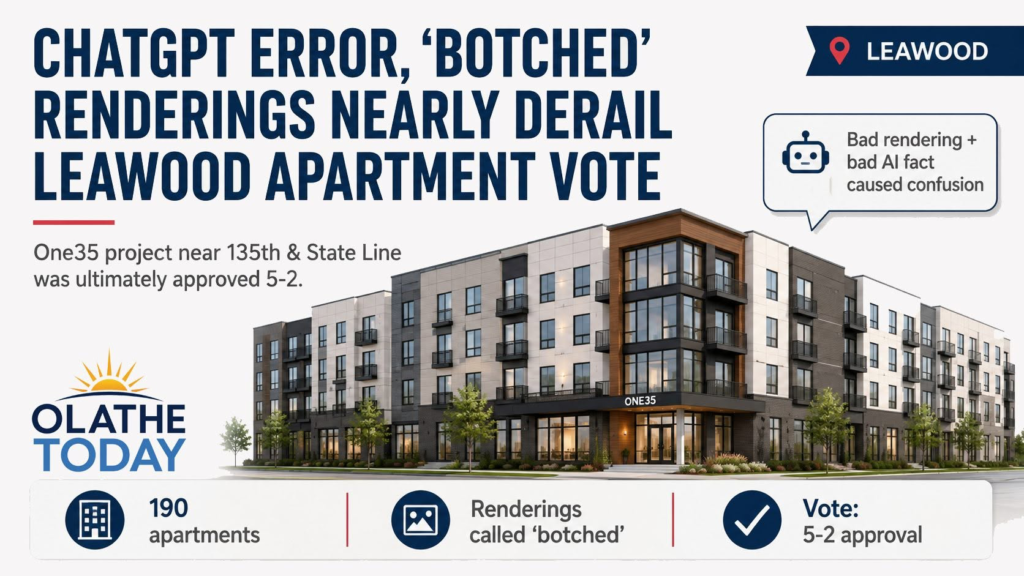
A Leawood apartment project nearly hit an unexpected roadblock this week after confusing architectural renderings — and an incorrect answer from ChatGPT — left several City Council members questioning whether the project had suddenly become much larger than they remembered.
The project, called One35, is planned near 135th Street and State Line Road as part of the larger Regents Park development. It includes about 190 apartments spread across several buildings and has been moving through Leawood’s approval process for years.
But when the revised final development plan came before the City Council, the new renderings caused immediate concern.
Some councilmembers said the drawings made the project look enormous, especially one building along 135th Street that stretches roughly 640 feet. Because of the perspective used in the renderings, portions of the development appeared to blend together into one very long structure.
Councilmember Lisa Harrison said the building looked “really, really big and really, really long,” while others questioned whether what they were seeing matched the project they thought had already been approved.
That concern quickly led to an unusual comparison.
Councilmember Steve Kaster referenced the Eiffel Tower while trying to illustrate the scale of the building. He said the tower was about 400 feet tall, suggesting the 640-foot apartment building would be dramatically longer.
The problem? The Eiffel Tower is actually about 1,083 feet tall.
Later in the discussion, the developer’s attorney corrected the figure, and Kaster acknowledged that the incorrect 400-foot number had come from ChatGPT.
That moment became one of the more unusual parts of the meeting because the bad AI-generated fact had helped reinforce the impression that the building was exceptionally massive.
At the same time, the project team was also trying to explain that the renderings themselves were creating a distorted impression.
Architects told the council that the building is designed with changes in height, setbacks and facade treatments intended to break up its length visually. Those design changes were described several times during the meeting as “undulations.”
Councilmember Julie Cain was among those who criticized the presentation itself, calling it “botched” and saying the renderings had created unnecessary confusion about the scale of the development.
Once the architect and developer walked the council through the actual dimensions and explained how the perspective of the drawings was affecting what members were seeing, some of the concern eased.
The City Council ultimately approved the revised final development plan 5-2. Harrison and Kaster voted against the project, while Alan Sunkel was absent.
The One35 development will now continue moving forward, but the meeting ended up becoming about much more than apartments.
It became a real-world example of how quickly visuals and AI-generated information can shape a public discussion — even when both turn out to be misleading.
Architectural renderings are meant to help elected officials and residents understand what a project will look like, but perspective and presentation can sometimes make a building appear larger or smaller than it really is.
And while tools like ChatGPT can be useful for quick research, the Leawood discussion was also a reminder that AI-generated facts still need to be independently verified — especially before they are used during a public vote.
In this case, the project survived both the confusing drawings and the incorrect Eiffel Tower comparison.
But for a few tense minutes, a bad rendering and a bad AI answer almost helped derail a 190-unit Johnson County development.


 Something Different Media Group