

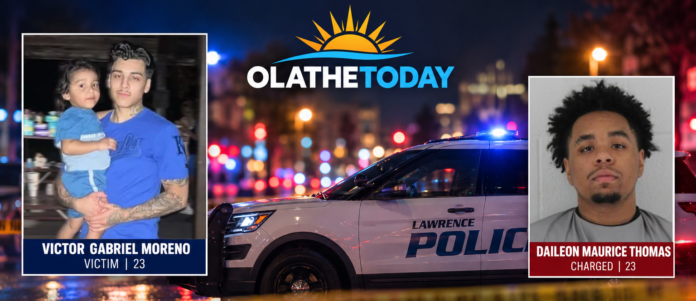
An Olathe man accused of fatally shooting a 23-year-old father in downtown Lawrence says he was trying to protect a coworker during a violent confrontation. But prosecutors say a witness saw him retrieve a gun from a vehicle before firing. A judge has refused to release him from jail, and his attorney plans to seek immunity from prosecution under Kansas self-defense law.
OLATHE, Kan. — A fatal shooting outside a downtown Lawrence food truck has become a sharply contested murder case, with attorneys offering dramatically different accounts of what happened in the moments before a 23-year-old man was killed.
Daileon Maurice Thomas, 23, of Olathe, is charged with intentional second-degree murder in the Oct. 18 shooting death of Victor Gabriel Moreno, 23, of Lawrence.
During a Thursday, Oct. 29, hearing in Douglas County District Court, Thomas’ attorney argued that his client fired a gun to protect another worker who was allegedly being choked and beaten during a confrontation.
Prosecutors strongly disputed that account, describing the evidence against Thomas as overwhelming and citing a witness who reportedly saw him retrieve a gun from a Lexus, point it at Moreno and fire.
Douglas County District Judge Stacey Donovan rejected a defense request to release Thomas without requiring him to post bond.
He remains in the Douglas County Jail on a $500,000 cash or surety bond.
The new developments, reveal significant details about the events leading up to the shooting that authorities had not previously made public.
They also establish the central question that could determine the outcome of the case: Was Thomas using legally justified force to protect someone from serious injury, or did he intentionally shoot Moreno without legal justification?
What happened outside the food truck?
The shooting occurred shortly after 3 a.m. Sunday, Oct. 18, in a parking lot in the 700 block of New Hampshire Street, near Seventh Street in downtown Lawrence.
According to Lawrence police, officers responded after receiving reports of gunfire.
They discovered Moreno suffering from a gunshot wound and immediately began providing emergency assistance.
Lawrence-Douglas County Fire Medical personnel took over care at the scene, but Moreno was pronounced dead.
Initially, police released few details about what led to the confrontation.
Investigators said they had no reason to believe Moreno and Thomas knew each other before that night.
The defense account presented Thursday offered a new explanation.
According to a written motion filed by attorney Branden Smith, Thomas was working at his mother’s food truck when a fight broke out nearby.
Smith alleged that another worker was being choked and beaten and that Thomas fired the fatal shot while attempting to protect that individual.
The defense maintains that Thomas’ actions were justified under Kansas law, which permits the use of force in certain circumstances to protect oneself or another person.
Those allegations have not been established as facts in court.
Prosecutors describe a different sequence of events
Senior Assistant District Attorney Eve Kemple challenged the defense account during Thursday’s hearing.
Kemple told the judge that investigators had thoroughly examined the case and collected substantial evidence.
She cited a witness who reportedly observed a physical confrontation before seeing Thomas go to a Lexus, retrieve a firearm, point it at Moreno and shoot.
That account could become particularly important because the timing and circumstances of the gun’s retrieval may be central to determining whether deadly force was legally justified.
The defense argues that Thomas was responding to a dangerous attack on another person.
Prosecutors dispute that the shooting was justified.
The competing accounts leave several significant questions unresolved.
Was someone facing an immediate threat of death or serious bodily injury when Thomas fired? What happened between the initial confrontation and the shooting? Did the danger described by the defense still exist at the moment the gun was fired?
Those questions may depend on witness testimony, surveillance recordings and other evidence presented in court.
The prosecution’s description of a witness account is not itself a judicial finding that the shooting was unjustified.
Likewise, the defense’s assertion of self-defense has not been accepted by the court.
Police recovered a firearm and reviewed video evidence
The initial police investigation involved more than witness interviews.
Following the shooting, Lawrence detectives examined public and private surveillance recordings from the downtown area, reviewed license plate reader information and interviewed people who may have witnessed the incident.
Investigators also recovered a firearm they believe was involved in Moreno’s death.
Police said those investigative steps allowed them to reconstruct events, identify people involved and ultimately locate Thomas.
He was arrested without incident shortly after 8 p.m. Monday, Oct. 19, approximately 41 hours after the shooting.
The Lawrence Police Department initially recommended a charge of first-degree murder.
However, when prosecutors formally filed the criminal case on Wednesday, Oct. 21, they charged Thomas with intentional second-degree murder.
That is the charge currently pending against him.
Intentional second-degree murder is classified as a severity-level 1 person felony under Kansas law.
The difference between the police recommendation and the formal charge is important because investigators may recommend criminal charges, but prosecutors determine what charges are filed based on the available evidence and applicable law.
Defense plans to seek immunity under Kansas law
Thomas’ attorney has indicated that he intends to pursue immunity from prosecution based on the claim that his client acted in self-defense or defense of another person.
Kansas law provides specific protections for individuals who reasonably believe force is necessary to protect themselves or others.
Under Kansas Statute 21-5222, deadly force may be justified when a person reasonably believes it is necessary to prevent imminent death or great bodily harm to themselves or another person.
Kansas law also provides that a person who is otherwise justified in using force is not required to retreat.
A separate statute, K.S.A. 21-5231, establishes immunity from criminal prosecution and civil liability for qualifying uses of force.
Those provisions do not mean that every shooting during a fight is legally justified.
The circumstances must satisfy the requirements established by law.
In particular, claims involving deadly force require consideration of whether the person using it reasonably believed that death or great bodily harm was imminent.
Kansas law also contains limitations involving people who provoke confrontations or are engaged in certain criminal conduct.
If Thomas formally seeks immunity, a judge could be required to consider evidence and determine whether prosecutors have established probable cause that his use of force was not legally justified.
A successful immunity claim could prevent the case from proceeding to trial.
However, a claim of self-defense alone does not automatically provide immunity.
As of Thursday’s hearing, no ruling granting Thomas immunity had been announced.
The judge’s decision to keep him in jail was a bond determination, not a final ruling on whether his use of force was justified.
Prosecutors object to releasing Thomas to his mother’s Olathe home
The Olathe connection became an important issue during Thursday’s hearing.
Smith asked Judge Donovan to release Thomas on a personal-recognizance bond, which would allow him to remain out of jail while awaiting further court proceedings without posting a financial bond.
The attorney argued that Thomas was neither a flight risk nor a danger to the community.
Kemple disagreed.
She told the court that Thomas’ mother is a witness in the case and that releasing him to her Olathe residence could create problems with witness contact.
According to the prosecutor, other family members who could potentially be living at or visiting the residence are also witnesses.
Kemple argued that allowing Thomas to return to that environment could create opportunities to discuss the criminal case with people whose testimony may become important.
She also noted that Thomas had no significant connection to Lawrence, which she argued increased the concern that he could fail to appear for future proceedings.
The prosecutor additionally told the court that Thomas was participating in diversion related to an unrelated domestic battery case in Johnson County.
That information was presented as part of the state’s argument about whether Thomas should be released. Diversion is not itself a criminal conviction, and the underlying Johnson County case has not been independently reviewed by Olathe Today.
After considering the arguments, Donovan declined to modify the existing bond.
Thomas remains in custody.
Judge allows contact with his mother, but with restrictions
Although Donovan refused to release Thomas, she granted a separate defense request allowing him to communicate with his mother while incarcerated.
That permission comes with a significant condition.
Thomas may not discuss the pending murder case with her.
The judge warned that communications from the jail may be recorded and monitored, potentially revealing any prohibited discussion of the case.
The restriction reflects the concern prosecutors raised about contact between Thomas and witnesses.
It also allows the defendant to maintain family contact while the criminal case proceeds.
A family mourns a young father
While the legal arguments continue, Moreno’s family is grieving the death of a young man who leaves behind a 4-year-old son.
Moreno, also known to family and friends as Gabe, was remembered by loved ones as a caring person with close family relationships.
His adoptive father, Cliff Phillips, spoke publicly about the loss in an earlier interview with KMBC 9 News.
Phillips described raising Moreno as one of the most important experiences of his life.
Moreno’s former elementary school teacher, Adela Solis, also recalled him as a kind, honest and loyal student.
Phillips attended Thursday’s court hearing.
He shook his head while the defense attorney argued that Thomas had acted in self-defense.
For Moreno’s family, the court proceedings are unfolding less than two weeks after his death.
His young son, Valentino, now faces growing up without his father.
Friends of the family have established a GoFundMe campaign to assist with funeral and memorial expenses and provide financial support for Valentino’s future.
The fundraiser, organized by David Slade and Jeffrey Burns for Phillips, states that contributions remaining after memorial expenses will be directed toward an education savings account for the child.
The organizers intend the account to help cover educational needs from preschool through college or vocational training.
The campaign is titled “In honor of Gabe and to support his son, Valentino.”
What happens next?
Thomas is scheduled to return to Douglas County District Court for a scheduling conference on Nov. 24.
That hearing may establish additional dates and procedures for the criminal case.
His attorney has indicated that he plans to request immunity based on the self-defense claim, but the timing of any hearing on that issue has not been established in the information publicly reported Thursday.
The defense may also renew its request for a bond modification as additional evidence becomes available.
For prosecutors, the case will involve establishing that Thomas committed intentional second-degree murder and overcoming any legally sufficient claim of justified force.
For the defense, the central issue will be whether Thomas reasonably believed deadly force was necessary to protect another person from imminent death or great bodily harm.
The case may ultimately depend on a detailed reconstruction of the confrontation, including the actions of the people involved immediately before the fatal shot.
Surveillance video, forensic evidence and witness testimony could play important roles in resolving those questions.
For now, the two sides remain sharply divided over what happened outside the food truck in the early morning hours of Oct. 18.
Thomas remains charged with intentional second-degree murder and is presumed innocent unless and until proven guilty in court.
Moreno’s death, meanwhile, has left a family grieving and a young child without his father.
The next court proceedings will help determine whether the shooting was legally justified or whether Thomas must stand trial for murder.


 Something Different Media Group
