

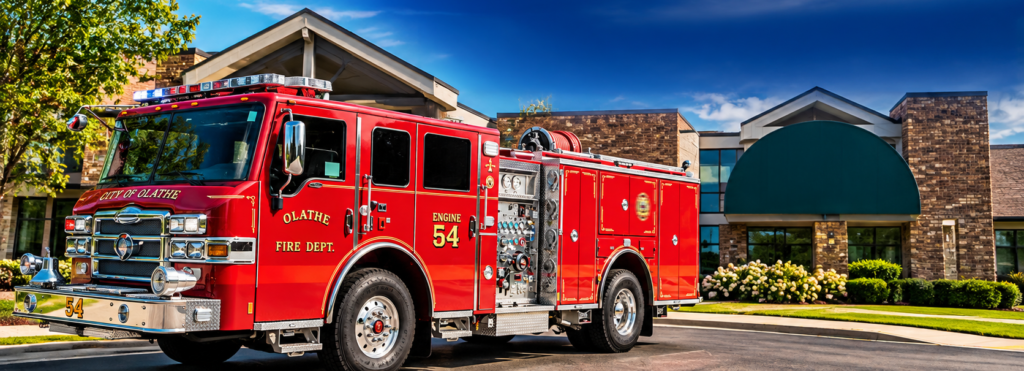
OLATHE, Kan. — When someone falls at an assisted-living or memory-care facility in Olathe and cannot get back up, staff members may call 911. A fire truck and its crew respond, firefighters help the resident off the floor, and the facility is not charged for the service. It happens every day, according to Olathe’s fire chief, and some City Council members are beginning to question whether taxpayers should continue providing that assistance at no additional cost to businesses that charge thousands of dollars a month to care for their residents.
The issue surfaced during Tuesday’s City Council meeting when Councilmember LeEtta Felter described something she learned while touring memory-care facilities for a family member. Felter said she was surprised to discover that some facilities rely on firefighters to lift residents who have fallen, even when the facility has medical personnel on staff. With Olathe facing significant budget pressures, she questioned whether the city should be routinely dispatching emergency crews to perform work that some care facilities might be equipped to handle themselves.
Felter said she had encountered facilities charging as much as $10,500 a month and wondered why the cost of providing lift assistance was being shifted to the city’s emergency services.
“I was just rather appalled,” Felter told the council, questioning whether the practice represented an unnecessary use of city resources.
Fire Chief Jeff DeGraffenreid confirmed that the practice is common and that Olathe firefighters regularly respond to what emergency services call “lift assists.” These calls generally involve helping someone who has fallen or otherwise become unable to move without physical assistance. Sometimes the person has an injury or medical condition requiring emergency care. In other cases, firefighters arrive to find someone who simply needs help getting back into bed or into a chair.
DeGraffenreid said the department has provided the service for years and does not charge the facilities for those responses.
“We do it every single day at numerous facilities,” the chief told councilmembers.
The practice is hardly unique to Olathe. Fire departments across the country have grappled with increasing requests for assistance at senior-living facilities, particularly as the population ages and more residents require help with mobility. Some departments have introduced fees for nonemergency lift assists, while others continue responding without charging because of concerns about patient safety and the difficulty of determining whether a fall involves a medical emergency.
For Olathe, the numbers suggest that lift assists have been a significant part of the fire department’s workload for years. A city fire department report documented 632 lift-assist responses in 2017, increasing to 710 in 2018 and 905 in 2019. The department recorded 835 in 2020 and 927 in 2021, bringing the five-year total to 4,009 calls.
Those historical figures include lift assists throughout the city, including private residences, and should not be interpreted as the number of calls specifically involving senior care facilities. Nevertheless, they demonstrate that helping people who cannot get up has long required a substantial amount of emergency-response time. The 2021 total alone averaged more than two and a half lift-assist calls per day.
DeGraffenreid did not provide an updated citywide total or a breakdown by facility during Tuesday’s meeting, but he told councilmembers the department could provide the information quickly.
That data could help answer one of the central questions raised during the discussion: Are Olathe firefighters frequently being called to the same facilities for relatively routine assistance, or are the calls spread across many locations and primarily related to legitimate medical emergencies?
WHEN IS A FALL A MEDICAL EMERGENCY?
DeGraffenreid cautioned against treating every lift-assist call as an unnecessary use of emergency services. Someone who appears to have fallen without injury could have suffered a stroke, experienced a medical episode or sustained an injury that is not immediately apparent. A person who cannot get up may need more than physical assistance, and firefighters are trained to recognize situations requiring additional medical care.
“I’ve never been to a lift assist where they were on fire, but I have been to a lift assist when somebody had a medical problem that caused them to be on the floor,” DeGraffenreid told the council.
Moving someone after a fall without first checking for injuries can create additional risks. Older residents may be especially vulnerable to fractures, head injuries and other medical complications, and a facility’s decision to summon emergency responders may sometimes be appropriate even when no injury is immediately obvious.
The chief said Olathe’s priority remains ensuring that people receive assistance when they need it. He also acknowledged that the current arrangement raises legitimate questions about which agency should respond and who should bear the cost.
Olathe has discussed the matter with its ambulance provider, including whether certain calls should initially be handled by an ambulance rather than a fire apparatus. But DeGraffenreid noted that the county has more fire apparatus than ambulances, creating practical challenges for changing the response system. Sending an ambulance to every lift-assist call could place additional demands on resources needed for other medical emergencies.
The department also operates a Mobile Integrated Healthcare program intended to help residents whose needs may not require a traditional emergency response. Such programs can connect patients with appropriate care and services, especially when repeated calls suggest a person needs additional assistance to remain safe.
COUNCILMEMBERS QUESTION WHO SHOULD PAY
Felter said she understands the importance of responding when someone falls at home or at a facility without medical personnel. Her concern was whether assisted-living and memory-care businesses should routinely depend on the fire department to provide physical assistance that their employees might otherwise be expected to perform.
She described the expense of dispatching a staffed fire apparatus, including fuel, equipment and the time firefighters spend away from their stations.
“When is it our responsibility and when is it someone else’s?” Felter asked.
Councilmember Dean Vakas also questioned the practice, drawing on his family’s experience with assisted living. He said facilities that accept residents needing daily assistance should have adequate personnel available to help them safely.
Vakas suggested the city should examine whether facilities are meeting their staffing responsibilities and whether Olathe should consider recovering some of the cost of responding to nonemergency calls.
Other councilmembers discussed the distinction between emergency assistance and services that might more appropriately be provided by a private operator. The concern was not that firefighters should refuse to help someone in danger, but whether all such requests require the same emergency response and whether repeated nonemergency calls should remain free to the facility requesting assistance.
OTHER CITIES ALREADY CHARGE FOR LIFT ASSISTS
Olathe would not be the first community to examine charging senior care facilities for some of these calls.
Kansas City, Missouri, adopted an ordinance in 2018 allowing its fire department to assess fees against licensed residential care, assisted-living and nursing facilities when firefighters are called to provide nonemergency lift assistance. The city’s ordinance distinguishes these calls from incidents requiring emergency medical treatment or patient transportation, and fees are intended to help recover the cost of providing the service.
Other communities have adopted similar policies, often targeting repeated calls to the same facility rather than charging residents for legitimate medical emergencies. Such policies have generated debate within the senior-living industry, where operators argue that residents of care facilities should continue receiving emergency assistance just as residents of private homes do.
DeGraffenreid acknowledged that charging facilities does not necessarily mean the expense disappears. Operators may ultimately pass additional costs along to residents through higher monthly rates or other fees.
That creates another consideration for Olathe, where families are already paying substantial amounts for assisted living and memory care. A policy intended to recover taxpayer expenses could ultimately increase costs for older residents and their families.
Kansas regulations require assisted-living facilities to maintain sufficient qualified personnel to meet residents’ needs under their care plans and service agreements. They also require appropriate staff to remain available and responsive. Those requirements do not necessarily mean every employee can safely lift every fallen resident, however, and the circumstances surrounding a particular call would matter in determining whether a facility was adequately staffed.
Licensing and regulation of assisted-living facilities are primarily responsibilities of the Kansas Department for Aging and Disability Services, rather than the Olathe City Council.
No individual senior care facility was identified during Tuesday’s discussion as having violated staffing requirements or improperly requested emergency assistance.
CITY WILL EXAMINE THE NUMBERS
For now, Olathe has not adopted a new fee, changed its emergency-response procedures or directed firefighters to stop responding to lift-assist requests.
The immediate next step is gathering information about how frequently the calls occur, where they originate and how much time they require. Felter asked whether the department could provide that information, and DeGraffenreid indicated it was readily available.
Such records could reveal whether a relatively small number of facilities account for a disproportionate share of the requests, how often those calls result in medical treatment or transportation, and whether some incidents could be handled safely without dispatching a fully staffed fire apparatus.
They could also help the council determine whether a fee would recover meaningful revenue or merely shift costs to seniors and their families.
The discussion comes as Olathe works through a series of expensive public safety needs. At the same meeting, the council approved $2.21 million in critical repairs to Fire Station No. 1, where shifting walls, settling floors and other structural problems have complicated daily operations. The city has also postponed some planned facilities because of budget constraints.
Against that financial backdrop, Felter suggested it makes sense to examine services the city has historically provided without charging a separate fee.
DeGraffenreid did not propose an immediate solution. He acknowledged that the department has discussed the problem for years and that finding the right balance between patient safety, staffing responsibilities and emergency-service costs will require additional work.
For Olathe residents, the issue raises a question that extends beyond the fire department: When families pay thousands of dollars each month for senior care, which services should the facility provide, and when should taxpayers be expected to help?
The City Council now has an opportunity to examine the numbers before deciding whether Olathe’s longstanding approach needs to change.


 Something Different Media Group