

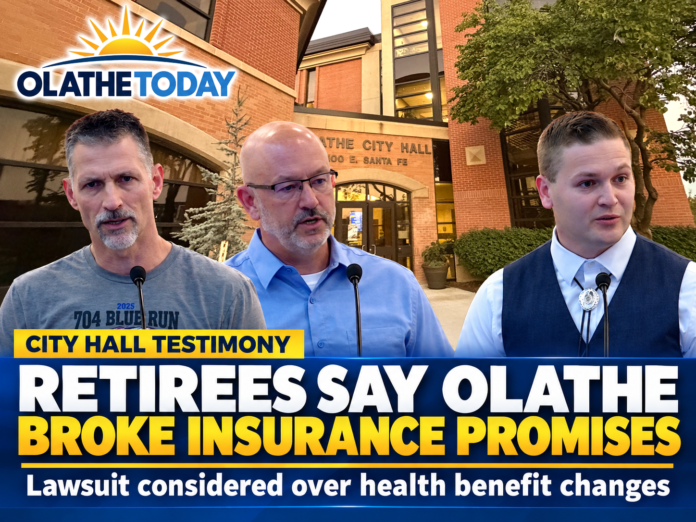
OLATHE, Kan. — A dispute over health insurance benefits for retired Olathe employees is growing more serious, with a longtime police officer telling the City Council that attorneys are considering whether a class-action lawsuit could be brought against the city. The warning came Tuesday night as three current and former city employees urged elected officials to reconsider changes they say are forcing retirees to pay substantially more for medical coverage they expected to receive at discounted rates.
The controversy began last year when retired police officers, firefighters and other former city employees learned that their health insurance premiums would increase significantly in 2026. Some retirees reported increases of several hundred percent, prompting objections at City Council meetings and eventually leading Olathe to offer a temporary $250 monthly subsidy for certain plans. Now that assistance is scheduled to end, and retirees are facing another round of higher costs in 2027.
For some, the issue is not simply the amount of money involved. They say they accepted jobs, remained with the city for decades and planned their retirements based partly on assurances that affordable health insurance would remain available until they qualified for Medicare at age 65.
Eric Hardman, a 26-year Olathe employee who identified himself Tuesday as a current police officer, told councilmembers that the changes amount to a betrayal of those expectations.
“This is not about policy. It’s about trust,” Hardman said. “Retirees planned their lives around the assurance that their health care at employee rates would be there.”
Hardman argued that longtime employees made financial decisions based on benefits the city had emphasized throughout their careers. He said the changes could force some retirees to spend thousands of additional dollars annually on insurance, creating financial hardships for people who have already left the workforce.
Hardman also delivered the meeting’s most significant warning, telling councilmembers he had consulted an attorney familiar with municipal government about whether the changes could justify legal action.
“I have spoken to an attorney who is familiar with city government, and they are speaking to their firm to determine if a class action lawsuit would be warranted on behalf of all those affected by this change,” Hardman said.
His remarks do not establish that a lawsuit has been filed or that an attorney has agreed to pursue one. They do, however, show that at least one employee is exploring whether the dispute could move beyond City Hall and into the courts.
Hardman urged the city to restore the previous benefits for people who have already retired or spent much of their careers working under the earlier system. If changes are necessary, he argued, they should apply to future employees who would have an opportunity to understand the benefits before accepting employment.
“A promise made should be a promise kept,” he told councilmembers.
RETIRED POLICE OFFICER OFFERS ALTERNATIVES
Retired Olathe police Sgt. Brian Wessling, who spent 32 years serving the community, also addressed the council. He argued that the city has other financial options and should not balance its budget by transferring additional health insurance costs to retirees.
Wessling proposed reducing a monthly employee benefit contribution he described as $100 to $81, saying the difference could generate savings that might be redirected toward retiree insurance. Using his estimate of approximately 790 employees, he calculated that the change could free up more than $180,000 annually.
That calculation works out to approximately $180,120 a year, assuming all 790 employees receive the same contribution and the full $19 difference could legally and practically be redirected. Those assumptions have not been independently verified, and the city has not publicly agreed that the proposal would produce the savings Wessling described.
Wessling also questioned whether the city could use additional property tax revenue to offset the insurance increases. He contended that higher property values had generated revenue beyond what officials originally budgeted and argued that a relatively small portion could help honor the benefits retirees say they were promised. His revenue estimates and the availability of those funds would require confirmation from the city’s Finance Department.
He also criticized the city’s participation in economic development financing arrangements while retirees are being asked to absorb higher medical costs. City officials have previously described significant budget pressures, including rising operating expenses and infrastructure needs, but Wessling argued that those pressures should not erase commitments made to longtime employees.
For retirees who spent much of their adult lives in city service, he said the dispute is changing how they view their former employer. Rather than becoming ambassadors who encourage others to work and live in Olathe, Wessling said some retirees now feel the city has abandoned them.
CURRENT EMPLOYEES ARE WORRIED, TOO
The concerns are not limited to people who have already retired. Benjamin Abel, a current Olathe employee with approximately three years of city service, told councilmembers the controversy has raised questions about the reliability of benefits offered to employees who are still years away from retirement.
Abel said Olathe’s competitive compensation and benefits were among the reasons he chose to work for the city. He described a workplace where employees value their jobs and want to serve the community, but are becoming increasingly concerned about what benefits will remain available in the future.
According to Abel, he knows employees who are postponing retirement because they can no longer afford to leave their jobs under the revised insurance arrangements. He also raised concerns about the planned elimination of retiree health-benefit account contributions, which he said would add to the financial burden.
The controversy could have consequences beyond the retirees currently affected. Olathe competes with other Johnson County communities for experienced police officers, firefighters and other public employees. If workers become less confident in the benefits being offered, Abel warned, the city could have greater difficulty retaining employees and recruiting replacements.
WHAT CHANGED — AND WHAT THE CITY SAYS
Olathe’s generous retiree health insurance benefits date back decades. The city began offering favorable insurance arrangements in the late 1980s as part of an effort to recruit and retain employees. The program evolved over time, including changes in 2005 that introduced different contribution arrangements depending on an employee’s circumstances and retirement eligibility.
The latest controversy followed the city’s decision to reduce its contribution toward retiree health insurance premiums beginning in 2026. Retirees who previously paid relatively modest amounts for coverage found themselves facing much higher monthly bills, depending on their selected plans and whether they insured spouses or other dependents.
In response to complaints last year, the city introduced a $250 monthly subsidy for certain retiree plans. That assistance was intended to ease the transition but was not established as a permanent benefit.
The impact of its expiration is becoming clear. Wessling has described paying approximately $250 per month for his individual coverage in 2026 after the subsidy, with his cost increasing to $529 per month in 2027. That would mean roughly $3,350 more in annual premiums for individual coverage alone.
The city maintains that rising health care expenses have forced difficult decisions and that Olathe continues to provide competitive benefits compared with other municipalities.
In a statement issued Tuesday, the city said it had communicated its multiyear benefits strategy to retirees, including the temporary nature of the $250 subsidy and plans to phase out contributions to retiree Voluntary Employees’ Beneficiary Association, or VEBA, accounts by 2027.
Olathe also said it continues to contribute 50% toward the total premium for an individual retiree’s health insurance plan. City officials maintain that many surrounding municipalities require retirees to pay substantially more of their insurance costs.
The city says these adjustments are part of its response to a projected structural budget imbalance, rising operating deficits and double-digit health insurance premium increases affecting both current employees and retirees. Officials have argued that maintaining previous contribution levels indefinitely would place additional pressure on city finances and potentially jeopardize other services and benefits.
The city also disputes the suggestion that retirees were given no warning about the 2027 changes. Officials say they provided information throughout the year about possible premium adjustments and the scheduled expiration of temporary assistance. Retirees, however, maintain that the broader changes have disrupted retirement plans developed over many years.
DOES KANSAS LAW REQUIRE THE CITY TO PAY RETIREE PREMIUMS?
Kansas law provides an important distinction in the dispute.
Under K.S.A. 12-5040, local governments that offer employee group health insurance generally must make continued coverage available to qualifying retirees. The law applies to retirees meeting certain service and eligibility requirements and permits the coverage to end under specified circumstances, including reaching age 65.
However, the law does not require local governments to subsidize the cost of that insurance. It allows retirees to be charged up to 125% of the premium cost for similarly situated employees, including administrative costs, while permitting cities to pay all or part of those expenses.
That means the legal requirement to make coverage available is not necessarily the same as a requirement to maintain the contribution levels that retirees received in previous years.
Whether Olathe made additional enforceable commitments through its personnel policies, benefit documents or other representations is a separate question. The fact that retirees say they were promised employee-rate coverage does not, by itself, establish that the city has violated a contract or state law. Those are among the issues an attorney would have to evaluate before pursuing a lawsuit.
DISPUTE CONTINUES AS THE CITY PREPARES FOR 2027
Tuesday’s testimony came amid broader discussions about Olathe’s financial challenges. During the same City Council meeting, officials discussed spending $2.21 million to repair deteriorating conditions at Fire Station No. 1 because the city cannot currently afford its planned replacement. Councilmembers also discussed other major capital projects that remain unfunded.
For retirees, those financial pressures have become central to the argument over whose expenses should be reduced and which commitments should take priority.
The speakers asked councilmembers to reconsider the health insurance changes, but the issue came during the public-comment portion of Tuesday’s meeting. No vote to restore benefits was taken, and councilmembers were not required to respond to the speakers at that time.
The city has not announced a reversal of its 2027 retiree insurance arrangements, and no class-action lawsuit has been confirmed as filed.
For now, retirees face the prospect of adjusting their household budgets again, while current employees are watching the dispute for clues about what their own retirement benefits may look like years from now.
The central disagreement remains unresolved. Olathe says it must balance employee benefits against rising costs and its responsibility to taxpayers. Retirees say they fulfilled their commitments to the city and expect the city to honor what they were told throughout their careers.
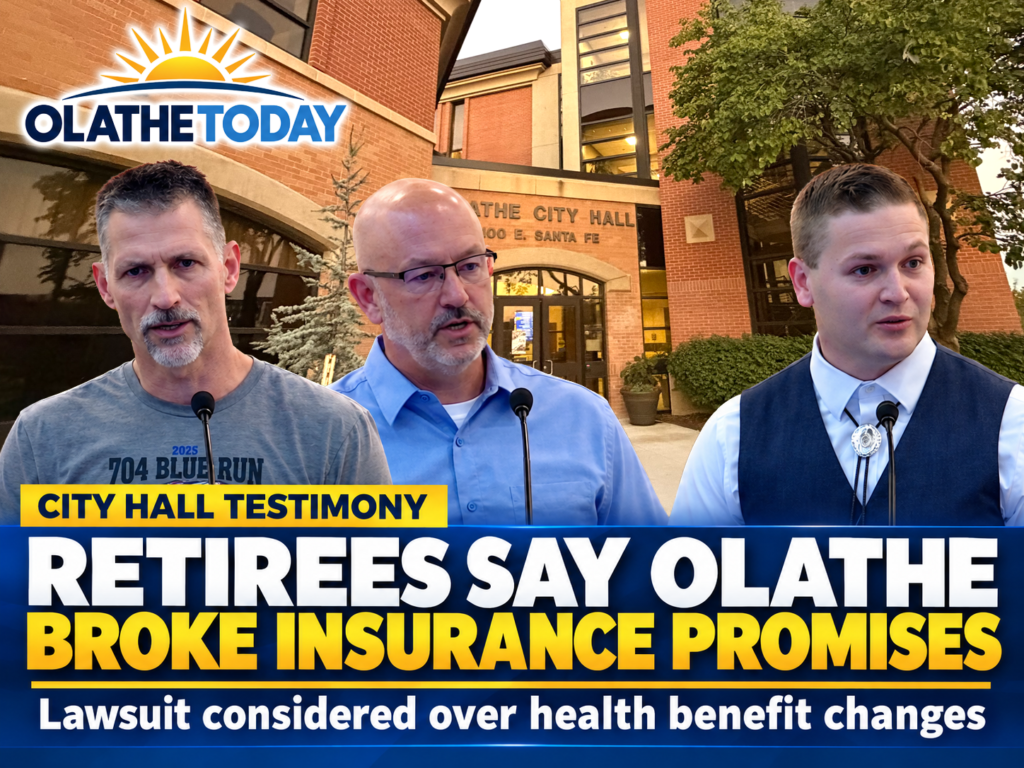
From left: Retired Olathe police Sgt. Brian Wessling, current Olathe police officer Eric Hardman and city employee Benjamin Abel address the Olathe City Council on Oct. 20, 2026, raising concerns about changes to retiree health insurance benefits. Hardman said a possible class-action lawsuit is being considered.


 Something Different Media Group
