

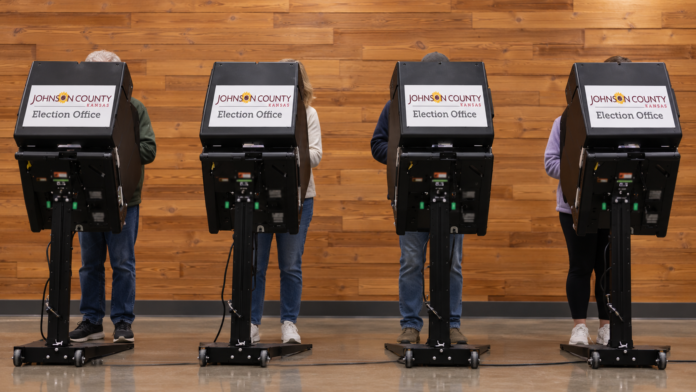
Kansas already prohibits noncitizens from voting. So why are voters being asked to change the state constitution? The answer has sparked a debate over election laws, local government authority and whether the amendment solves a problem that actually exists.
OLATHE, Kan. — When Olathe residents head to the polls Nov. 3, they’ll be asked to make a decision that could change the Kansas Constitution.
The question sounds simple: Should the state’s constitution explicitly say that only United States citizens can vote?
But there’s something voters should know before marking their ballots.
Noncitizens are already prohibited from voting in Kansas elections.
That fact is at the center of a debate over a proposed constitutional amendment that supporters say would eliminate any uncertainty about voter eligibility, while opponents argue it would change the constitution without addressing an actual problem.
The proposal will appear on ballots throughout Kansas, including in Olathe and the rest of Johnson County.
What exactly would change?
The amendment would rewrite part of Article 5, Section 1 of the Kansas Constitution, which establishes who qualifies to vote.
Currently, the constitution states:
“Every citizen of the United States who has attained the age of eighteen years and who resides in the voting area in which he or she seeks to vote shall be deemed a qualified elector.”
The proposed amendment takes a different approach.
Instead of describing who qualifies to vote, it would explicitly state that no person qualifies unless that individual is a U.S. citizen, is at least 18 years old and meets applicable residency requirements.
The difference may appear subtle, but supporters argue it is important.
They contend the current wording could potentially be interpreted to allow local governments to extend voting rights to noncitizens in certain municipal elections.
The amendment is intended to eliminate that possibility.
What does voting YES or NO mean?
A YES vote would approve the new constitutional wording, explicitly making U.S. citizenship a requirement for voter eligibility.
A NO vote would leave the existing constitutional language unchanged.
Neither choice would immediately change who is legally permitted to vote in Olathe. Under current Kansas law, noncitizens cannot vote in city, county, state or federal elections.
The disagreement is about whether the constitution needs to say that more explicitly.
Could Olathe ever allow noncitizens to vote?
That’s one of the central questions behind the proposal.
In a handful of communities outside Kansas, local governments have approved measures allowing certain noncitizen residents to vote in municipal elections, even though they cannot participate in federal elections.
Supporters of the Kansas amendment point to those examples as evidence that states should make their constitutional language unmistakable.
Rep. Pat Proctor, a Republican from Leavenworth County who sponsored the proposal, has argued that the amendment would prevent alternative interpretations of Kansas election law.
During legislative hearings, Proctor questioned whether existing court decisions completely eliminate the possibility of noncitizen voting in local elections.
His position is that the constitution should leave no room for doubt.
But opponents argue Kansas has already settled the question.
They point to a 1924 Kansas Supreme Court decision addressing the state’s voting requirements and maintain that Kansas law already establishes citizenship as a requirement.
No proposal to allow noncitizen voting in Olathe is identified in the reporting surrounding this amendment.
Supporters say it’s about protecting elections
The proposed amendment received broad Republican support in the Kansas Legislature in 2025.
Every Republican in the state Senate and House voted in favor of placing the measure before voters, according to legislative voting records described in reporting by the Lawrence Journal-World.
The proposal also received support from some Democrats, including state Sen. Cindy Holscher, who is now running for governor.
During legislative hearings, Becky Arps of Americans for Citizen Voting argued that the change would help prevent Kansas municipalities from adopting policies similar to those approved in some communities elsewhere in the country.
Another organization, Opportunity Solutions Project, supported the amendment as a way to remove competing interpretations of the constitution.
Supporters maintain that a constitutional amendment provides stronger protection than relying on existing statutes or court interpretations.
Opponents question why it’s needed
The American Civil Liberties Union of Kansas and the League of Women Voters of Kansas opposed the amendment during legislative hearings.
Their argument is straightforward: Kansas already requires voters to be U.S. citizens.
Davis Hammet, president of Loud Light Civic Action, has argued that the proposal is redundant and could mislead voters into believing noncitizen voting is currently permitted in Kansas.
Opponents also question whether changing the constitution is appropriate when the existing law already establishes the same basic eligibility requirement.
The League of Women Voters told lawmakers that Kansas election officials already follow the law restricting voting to citizens.
Hammet has also criticized the political motivations behind the proposal, while Proctor has defended it as a necessary clarification.
Kansas isn’t alone
Similar amendments have appeared on ballots across the country.
In 2024, voters in eight states, including neighboring Missouri, approved constitutional changes explicitly restricting voting to U.S. citizens.
Many of those measures changed relatively few words, replacing phrases such as “every citizen” with language specifying “only citizens.”
The Kansas proposal follows the same general approach, although its wording is more extensive.
The issue has become part of a broader national debate over election security, citizenship and the authority of local governments to determine voter eligibility.
What Olathe voters should know before Election Day
For Olathe residents, the amendment is not a proposal to change the city’s voting procedures or establish a new local election policy.
It is a statewide constitutional question that will appear on the Nov. 3 general election ballot.
The practical question for voters is whether they believe Kansas should strengthen its constitutional language to prevent any future interpretation permitting noncitizen voting, or whether the existing language and laws already provide sufficient protection.
Supporters see the amendment as a safeguard.
Opponents see it as an unnecessary change.
And while both sides disagree sharply over the proposal’s purpose, they agree on one important point: Under current Kansas law, noncitizens are not permitted to vote.
Olathe voters will now decide whether that existing restriction needs to be stated differently in the state’s constitution.
Election Day is Tuesday, Nov. 3, 2026. Johnson County voters can obtain election information, polling locations and advance voting details through the Johnson County Election Office at jocoelection.org.


 Something Different Media Group
