

October 16, 2026 | Olathe Today
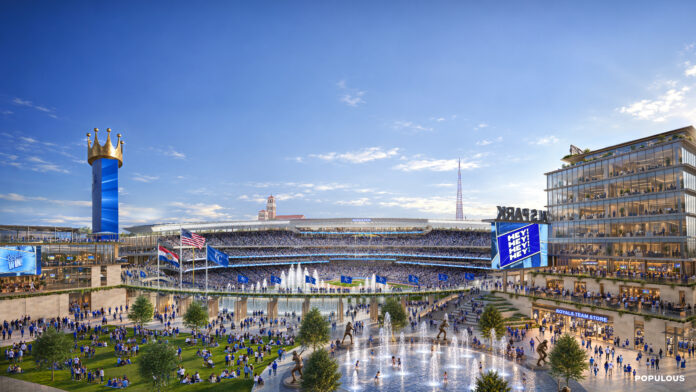
Plans call for a 34,000-seat ballpark at Crown Center, complete with the familiar Royals fountains, a massive CrownVision scoreboard, covered seating and an entirely new entertainment district. The team hopes to open the stadium in 2030.
KANSAS CITY, Mo. — For more than half a century, Kansas City Royals fans have made the trip to Kauffman Stadium, where the fountains beyond the outfield, the giant crown above the scoreboard and summer nights at the ballpark have become part of the city’s baseball identity.
Now, the Royals are offering their clearest look yet at what the next generation of Kansas City baseball could look like.
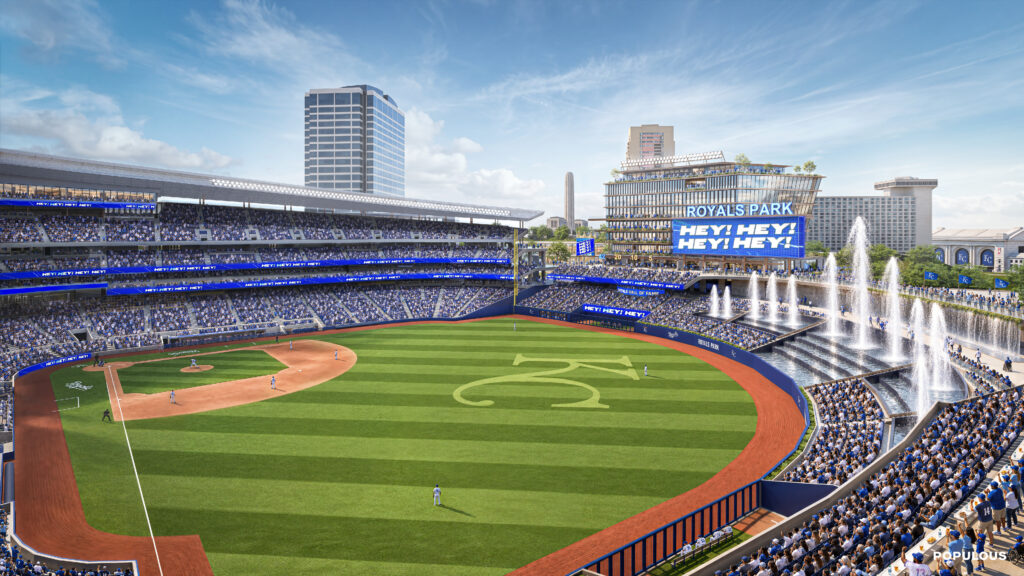
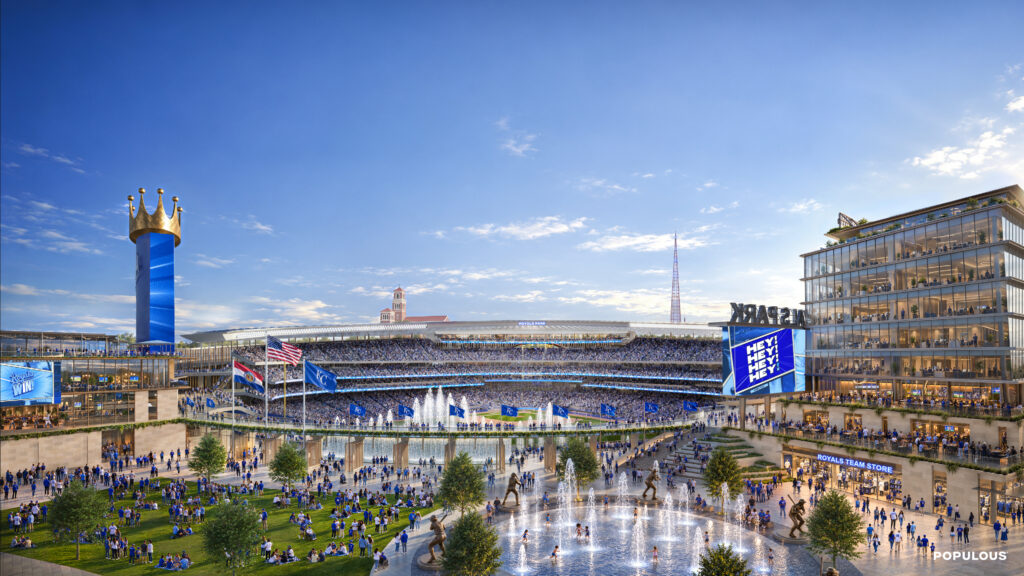
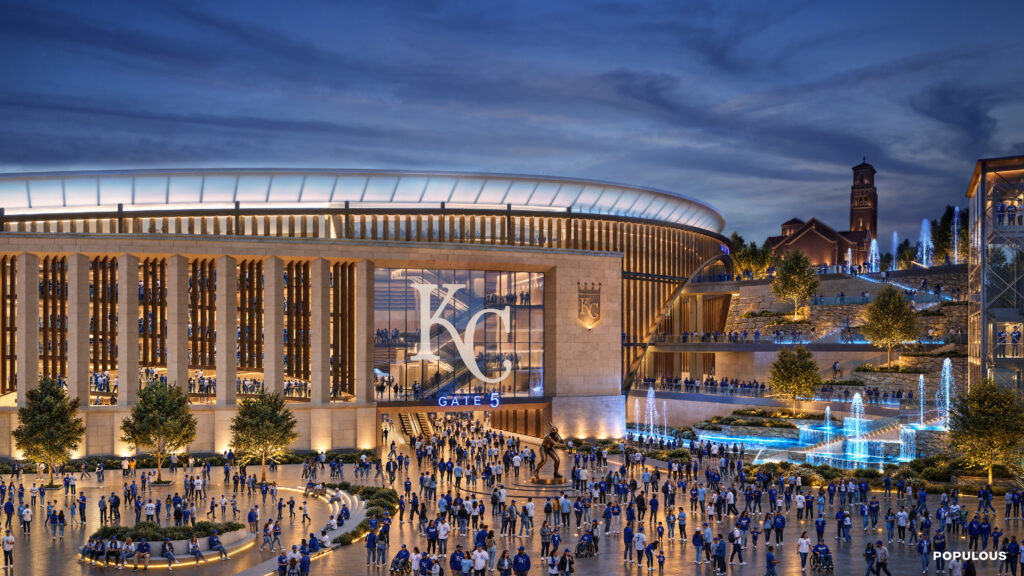
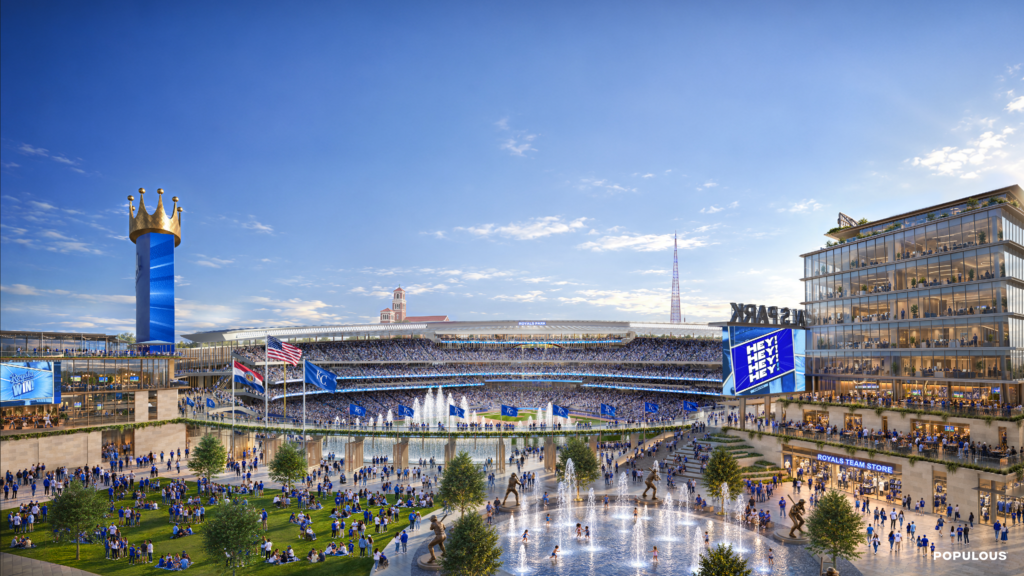
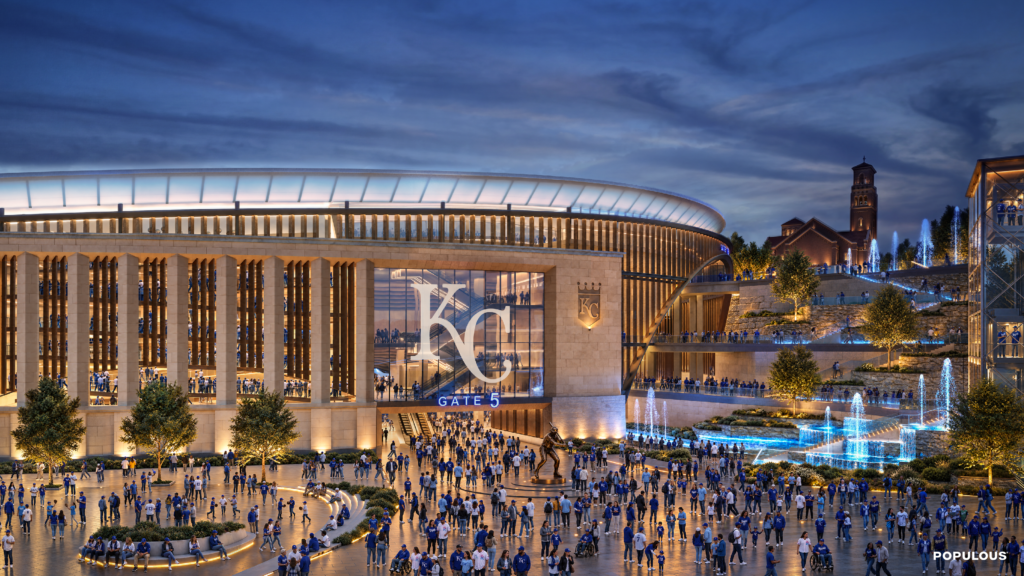
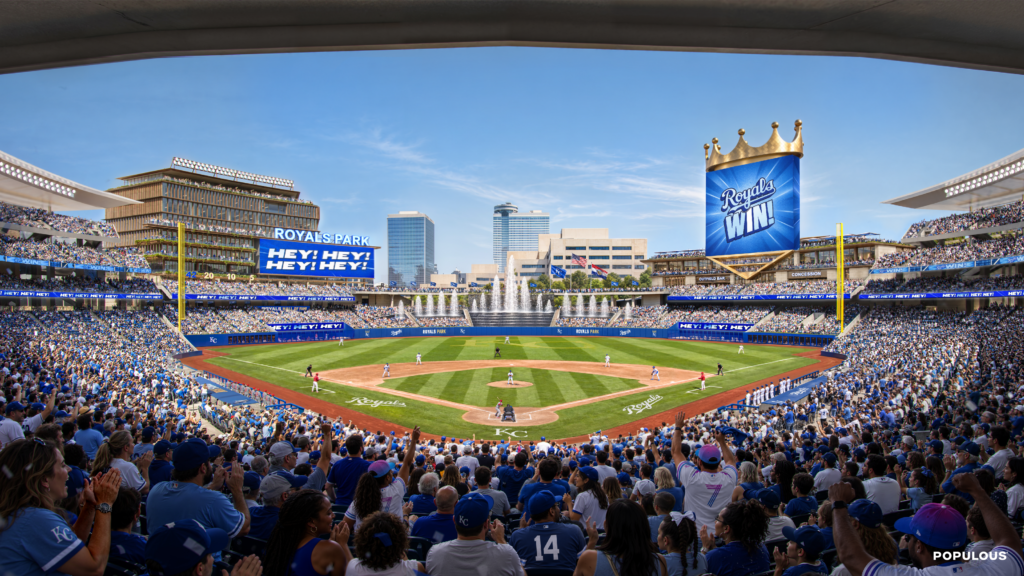
On Thursday, October 15, the team and Kansas City-based architecture firm Populous unveiled six new architectural renderings of a proposed downtown stadium at Crown Center. The images show an open-air ballpark surrounded by pedestrian plazas, fountains, entertainment spaces and downtown buildings, with sweeping views of the Kansas City skyline.
The announcement also confirmed Populous as the project’s architect of record, moving the development another step beyond the early conceptual drawings released when Crown Center was selected as the team’s future home.
The proposed stadium would seat approximately 34,000 fans, with room for another 3,000 in standing-room areas. It would be part of a larger redevelopment expected to represent roughly $3 billion in investment, including the ballpark and surrounding commercial, residential and entertainment development.
The Royals are targeting Opening Day 2030, although construction has not yet begun.
At a presentation held at Populous’ downtown headquarters, Royals chairman and CEO John Sherman described the decision to use a hometown architecture firm as an opportunity to create a ballpark that reflects Kansas City.
A NEW BALLPARK WITH FAMILIAR ROYALS TRADITIONS
Perhaps the most noticeable feature of the new design is how much effort has gone into preserving the identity of Kauffman Stadium.
The Royals have played at the Truman Sports Complex since 1973, and the team’s fountains have become one of the most recognizable features of any Major League Baseball stadium.
The latest renderings show that the fountains are not going away. Instead, designers envision a larger water feature extending across the outfield, incorporated into the architecture and gathering spaces beyond the playing field.
The familiar CrownVision scoreboard would also return in a redesigned form, featuring an oversized three-dimensional crown. The plans include a viewing area within the scoreboard structure where fans could watch the game from a new perspective.
The Little K, a miniature baseball field popular with younger fans, is also expected to survive the move downtown.
These details reflect an important balancing act for the Royals. The organization wants a smaller, more modern stadium surrounded by businesses and activity, but it also recognizes that fans have decades of memories tied to the features that made Kauffman Stadium distinctive.
Populous is designing the seating bowl to create a closer connection between spectators and the action on the field. The upper deck would be considerably smaller than Kauffman’s existing upper level, while the overall stadium capacity would be lower.
The development team has described plans for approximately 50 different fan experiences throughout the stadium, including family activities, entertainment areas and gathering spaces designed to keep people engaged beyond the nine innings.
A CANOPY WOULD SHADE MOST SEATS WHILE KEEPING BASEBALL OUTDOORS
One of the biggest differences between the new stadium and Kauffman would be the roof structure.
The ballpark would remain open-air, but a lightweight fabric canopy would extend over substantial portions of the seating bowl.
According to Populous, the canopy is designed to shade approximately 65% of seats during late-afternoon conditions, when summer heat can be particularly uncomfortable.
That could make a noticeable difference during Kansas City’s July and August home games, especially for families who have spent afternoons in the sun at Kauffman Stadium.
The roof would not enclose the playing field or turn the venue into a climate-controlled stadium. Fans would still experience outdoor baseball, including the weather conditions that come with it.
At night, the canopy could be illuminated in Royals colors, creating a distinctive new feature along the downtown skyline.
The design also includes two full 360-degree concourses, allowing spectators to move around the stadium while retaining views of the playing field and surrounding city.
An entertainment building is planned beyond right field, while the team’s headquarters would be incorporated into a building beyond left field.
Taken together, the changes suggest a stadium designed not simply as a place to sit and watch baseball, but as a destination where fans could spend several hours before and after a game.
WHY THE ROYALS CHOSE CROWN CENTER
The location is central to the team’s vision.
Rather than building another stadium surrounded by massive surface parking lots, the Royals want to create a neighborhood ballpark connected to existing downtown attractions, businesses, housing and public transportation.
The proposed stadium site sits within the Crown Center district, which has long been associated with Hallmark, one of Kansas City’s most prominent companies.
The partnership between the Royals and Hallmark is intended to transform portions of the district into a larger mixed-use destination with restaurants, entertainment, offices, residences and public gathering areas.
A broader master plan for the surrounding development is still being prepared, meaning many of the buildings and businesses that may eventually surround the stadium have yet to be finalized.
Populous has also placed considerable emphasis on incorporating the stadium into the area’s existing geography.
The site includes a significant elevation change between Grand Boulevard and Gillham Road. Rather than placing the entire stadium on top of the landscape, designers intend to build portions of the structure into the limestone bluff.
That approach would allow exposed limestone to become part of the stadium’s architecture, including entrances, interior concourses and gathering spaces.
The exterior would use limestone, terracotta and metal, materials inspired by landmarks such as Union Station, Municipal Auditorium and the National World War I Museum and Memorial.
Near Gillham Road, the design calls for the stadium to sit relatively low against the surrounding neighborhood. Plans presented Thursday indicate the structure would rise no more than about 38 feet above the adjoining grade on that side.
The goal is to create a building that feels connected to its surroundings rather than an enormous stadium towering over nearby homes and churches.
A $3 BILLION VISION THAT COMES WITH A SIGNIFICANT PUBLIC INVESTMENT
The project represents one of the largest proposed sports-related developments in Kansas City’s history, but the cost of building the new stadium has also generated substantial debate over how much taxpayers should contribute.
The overall redevelopment is projected at approximately $3 billion, including roughly $2 billion associated with the stadium and related facilities and additional investment in the surrounding district.
The financing framework includes a substantial contribution from the Royals organization, along with assistance from the state of Missouri and the city of Kansas City.
In September, the city’s Economic Development Corporation outlined a stadium financing plan involving approximately $911 million from the team and $1.14 billion from public sources, including state and city funding.
Kansas City’s planned contribution is approximately $600 million. In early October, the City Council approved a bond package totaling approximately $615 million, including construction costs, financing expenses and interest associated with the bonds.
The city intends to repay the debt using several revenue sources, including portions of future tax growth generated within a designated downtown stadium impact area.
That arrangement means some additional taxes generated by economic activity in parts of downtown would be redirected toward stadium debt payments for the next 30 years.
Supporters argue that the investment could attract additional businesses, create construction jobs, increase tourism and generate economic activity that otherwise might not occur.
Critics question whether the anticipated new tax revenue will be sufficient to repay the borrowing and whether some of those funds could be better spent on other municipal priorities.
The long-term cost is considerably greater than the initial bond amount because of interest. Financial estimates presented to Kansas City officials indicated potential debt service of approximately $1.39 billion over the life of the financing.
Two council members, Johnathan Duncan and Nathan Willett, voted against portions of the financing package, raising concerns about borrowing costs and the use of city revenue for the project.
The city has defended the agreement as a public-private partnership intended to keep the Royals in Kansas City while encouraging redevelopment of the Crown Center area.
The latest stadium renderings do not resolve that debate. They do, however, provide a clearer picture of what the public investment is intended to help build.
PARKING AND TRAFFIC REMAIN MAJOR QUESTIONS
For fans accustomed to driving directly to the Truman Sports Complex, one of the biggest changes will be getting to and from games.
Kauffman Stadium offers expansive parking areas surrounding the ballpark, allowing fans to arrive by car and walk a relatively short distance to the entrance.
The Crown Center location would rely on a combination of parking garages, nearby lots, public transportation, walking, cycling and rideshare services.
The Kansas City streetcar already serves the Crown Center area, connecting it with downtown destinations including the River Market, Power & Light District and the Country Club Plaza.
Royals officials hope the transportation options will encourage fans to arrive earlier, visit nearby restaurants and businesses, and remain in the district after games.
Existing Crown Center garages would remain part of the parking strategy. According to information presented by the development team, two existing garages provide approximately 4,000 spaces, and an additional garage is planned near the outfield.
However, the availability of parking does not eliminate concerns about congestion.
A traffic study completed in June estimated that approximately two-thirds of fans attending weeknight games would still arrive by automobile. Fewer than 20% were projected to walk, bike or use public transportation.
Nearby institutions, including Children’s Mercy, have also expressed concerns about protecting access for patients, families and emergency services when large crowds arrive downtown.
The Royals have said they are working with surrounding institutions and neighborhoods, but a detailed game-day traffic management plan has not yet been publicly finalized.
For fans traveling from Olathe and other Johnson County communities, the biggest practical difference could be the trip into downtown Kansas City rather than the familiar drive to the Truman Sports Complex.
Although highway access and parking arrangements will be important, the new location would also give suburban fans the option of parking elsewhere along the streetcar corridor and riding transit to the ballpark.
WHAT HAPPENS TO HALLMARK AND THE SURROUNDING NEIGHBORHOOD?
The new stadium is planned for land occupied by Hallmark’s existing headquarters facilities at Crown Center.
The company, which has deep roots in Kansas City, is working with the Royals on the redevelopment.
Demolition of the existing headquarters building is expected to begin in June 2027, according to the timeline discussed during Thursday’s presentation.
The larger development would transform portions of the surrounding property over multiple phases, but the final configuration of future offices, residential buildings, retail businesses and entertainment destinations has not been established.
The ballpark’s proximity to established neighborhoods also presents design challenges.
The Longfellow neighborhood and Our Lady of Sorrows Catholic Church are among the nearby landmarks that designers have considered in determining the building’s height, entrances and pedestrian connections.
The newly released images show plazas on several sides of the stadium, intended to connect the ballpark with the surrounding streets instead of isolating it behind fences and parking lots.
Royals officials have emphasized that they want the district to attract visitors even when the team is not playing.
Whether that vision becomes a year-round destination will depend on the businesses, housing and public spaces ultimately developed around the stadium.
A KANSAS CITY ARCHITECTURE FIRM WITH A NATIONAL REPUTATION
The decision to hire Populous brings the stadium design project to a firm that has helped shape professional baseball across the country.
Founded in Kansas City more than four decades ago, Populous has designed or contributed to numerous Major League Baseball ballparks, including Oriole Park at Camden Yards in Baltimore, Oracle Park in San Francisco, PNC Park in Pittsburgh, Yankee Stadium in New York and Target Field in Minneapolis.
The company has also worked with the Royals on renovations at Kauffman Stadium and the team’s spring training facility in Surprise, Arizona.
Populous senior principal Earl Santee grew up attending Kansas City Athletics games at Municipal Stadium before the Royals began playing in 1969.
He has emphasized that the new design should reflect its community rather than follow a generic stadium model.
The firm reports that approximately 90% of the new ballpark’s design team will be based in Kansas City, providing a significant hometown connection to the project.
Kansas City Mayor Quinton Lucas has promoted the project as an opportunity to generate construction employment and create long-term economic activity.
An economic development analysis estimates the stadium phase could support approximately 16,000 jobs during construction and preserve or create thousands of permanent, part-time and seasonal positions associated with stadium operations. Those figures are projections rather than guaranteed employment totals.
CONSTRUCTION COULD BEGIN NEXT YEAR, WITH A 2030 OPENING
The Royals have spent several years considering how to replace or substantially renovate Kauffman Stadium.
Previous concepts included locations in downtown Kansas City’s East Village, the Crossroads district and North Kansas City.
The selection of Crown Center brought the process closer to a specific location and eventually to detailed design and financing agreements.
Kansas City officials approved key development and financing measures in August and October, including zoning changes and the tax increment financing arrangements.
The current schedule calls for demolition and site preparation during 2027, followed by stadium construction extending through much of 2029.
The team hopes the facility will be ready for the beginning of the 2030 Major League Baseball season.
The timeline remains ambitious, with substantial demolition, excavation, infrastructure work and construction still ahead.
The Royals’ existing Kauffman Stadium lease extends through the 2030 season, giving the organization a contractual home while preparations for the downtown facility continue.
Team owner John Sherman has also expressed interest in eventually bringing the Major League Baseball All-Star Game back to Kansas City after the new stadium opens.
Kansas City last hosted the event in 2012 at Kauffman Stadium.
A NEW CHAPTER FOR ROYALS FANS ACROSS THE METRO
For generations of families in Olathe, Johnson County and across the Kansas City metropolitan area, attending a Royals game has meant heading east to Kauffman Stadium.
Many remember the 1985 World Series championship, the excitement of the 2014 postseason and the team’s return to the top of baseball with its 2015 World Series title.
They remember the fountains, the fireworks, the summer heat, the familiar view of the field and the generations of friends and family members who shared those experiences.
The proposed downtown stadium would change that tradition in a substantial way.
There would be a new drive, new parking arrangements and an entirely different setting for the game. Fans might walk past restaurants and downtown buildings rather than across a sea of parking spaces. Instead of the Truman Sports Complex, the backdrop would be the Kansas City skyline.
But the Royals are betting that the elements fans love most about Kauffman Stadium can make the move with them.
The fountains would remain. The crown would remain. Families would still be able to enjoy outdoor baseball on a summer evening.
And if the plans come together as envisioned, the team’s future home would be more than a replacement for a stadium that opened in 1973. It would become the centerpiece of an entirely new downtown neighborhood.
For now, the six renderings offer the clearest glimpse yet of that possibility.
The larger question is no longer simply where the Royals want to play. It is whether Kansas City can deliver the stadium, transportation improvements and surrounding development needed to turn the drawings into reality before the first pitch of the 2030 season.
Renderings courtesy of Kansas City Royals / Populous.


 Something Different Media Group
