

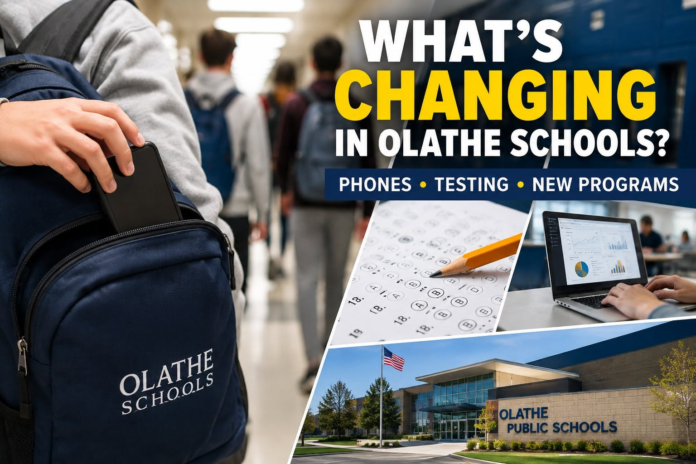
Olathe students returned to class this month with several changes that families are likely to notice during the 2026-27 school year — including tougher rules on cell phones and other personal electronics, a new way of handling state testing and the launch of a five-year strategic plan that reaches into everything from middle-school electives to bullying prevention.
Perhaps the most immediate change is the district’s updated personal electronic communications device policy. Under a new Kansas law, students must keep cell phones, smartwatches, personal tablets, wireless headphones and similar devices turned off and securely stored in an inaccessible location throughout the school day. The rule applies not only during class, but also during lunch, recess and passing periods. Exceptions are limited primarily to medical needs or requirements contained in a student’s IEP or Section 504 plan. Students can still use school-provided phones or communication devices when they need to contact a parent.
The new policy represents a noticeable shift for older students who may have previously been able to check their phones between classes or during lunch. Violations can result in confiscation of the device through the end of the school day, referral to administrators, parent notification or other consequences under the district’s student code of conduct.
Personal devices can still be used at school-sponsored events before or after the regular school day, subject to school rules.
Another significant change will be less obvious to students at first. Olathe is among the first Kansas school districts participating in a new statewide assessment model. Instead of relying entirely on a large state test near the end of the school year, Olathe will use quarterly assessments that are more closely connected to what students are actually learning in class.
Beginning this year, those quarterly assessments will replace the traditional end-of-year state tests in math and English language arts for grades 3 through 5 and in math for grades 6 through 8 and grade 10.
District officials say the advantage is timing. Traditional state-test results often arrive so late that they are of limited use to the teachers working with those students. Quarterly testing should give teachers information while the school year is still underway, allowing them to identify areas where students are struggling and adjust instruction sooner. The Kansas State Board of Education approved Olathe’s participation in the innovative assessment pilot earlier this year, following work that dates back to 2024.
Those changes are taking place as the district begins its new 2026-31 Strategic Plan, which Olathe Public Schools describes as a five-year roadmap for the district. Unlike a traditional plan adopted and largely left unchanged for five years, district officials say this one will be reviewed annually, with objectives updated as goals are completed. The plan was developed after an online survey, 12 community listening sessions and additional meetings with students and staff.
For families, some of the strategic plan’s goals could produce visible changes fairly quickly. Olathe plans to expand middle-school elective opportunities so students can explore career pathways and develop what the district calls future-ready skills. It is also implementing a district-wide bullying prevention plan intended to create more consistent definitions, reporting practices, staff training and student support across Olathe schools. The district’s goal is ultimately to reduce major discipline referrals by 10% by 2031.
Another new program is Compass, a K-8 alternative education program operating at the former Westview Elementary campus. Compass is designed for general-education students who need more intensive behavioral or social-emotional support. Students receive short-term, individualized intervention with the goal of eventually returning successfully to their regular school. Westview is the only school building being repurposed this school year; the district says no additional school consolidations are planned for 2026-27.
The strategic plan also places greater emphasis on career preparation. Olathe wants more students participating in its career-pathway programs and intends to make greater use of each student’s Individual Plan of Study when making decisions about college and career preparation. One long-term benchmark is raising the district’s ACT composite score to above 24 by 2031.
Families could also eventually notice changes in how the district communicates. One goal calls for a single unified communication platform for staff, students and families during the 2026-27 school year. The district is also beginning a broader review of buildings and enrollment, with a goal of developing a plan by February 2027 to better align the number of elementary and middle schools with current and projected enrollment. Those recommendations would affect future years, not the current school year.
Taken together, the changes make the 2026-27 school year something of a transition year for Olathe Public Schools. The most obvious difference for students may be a phone that stays put away from the opening bell until dismissal, but behind the scenes the district is also experimenting with a different way of measuring student progress and beginning a five-year effort that could reshape courses, student support, buildings and classroom instruction well beyond this school year.


 Something Different Media Group
