

Edgerton, KS; Edgerton voters will decide in March 2027 whether to prohibit high-impact data centers, bringing a months-long fight over an $860 million project southwest of Olathe to a special election.
The Edgerton City Council voted Nov. 12 to put the citizen-led proposal on the ballot after a Johnson County judge ruled that the city had to adopt the ordinance or let voters decide. A second proposal, targeting certain battery energy storage systems, will appear at the same election.
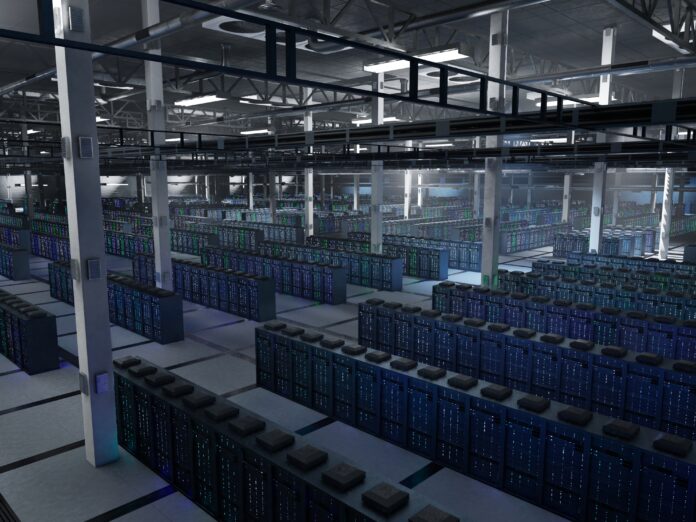
At the center of the data center controversy is DAMAC Digital’s Heartland project at Logistics Park Kansas City. The company proposes converting an existing 400,000-square-foot warehouse at 31800 W. 196th St. into a facility serving artificial intelligence, cloud computing and other large-scale computing customers.
The ballot proposal reaches beyond that property. It would establish a citywide prohibition on data centers exceeding specified power or water-use thresholds. The election belongs to Edgerton voters; it is not an Olathe or countywide referendum.
The measure defines a high-impact data center as a facility whose primary purpose is processing, storing or transmitting electronic data and whose peak electrical demand exceeds 10 megawatts or daily water use exceeds 100,000 gallons. Either threshold would qualify.
Ordinary office servers, school computer labs and similar equipment serving another primary use are excluded. The proposed prohibition covers construction, installation, operation and maintenance of qualifying facilities.
The proposal also has a longer potential reach than the phrase “10-year ban” suggests. It contains no automatic expiration date.
Under Kansas law, a petition-initiated ordinance adopted by the council or voters generally cannot be amended or repealed by the council for 10 years. Voters can approve changes or repeal before then. After 10 years, the council gains that authority; the ordinance does not disappear on its own.
That would make the election a consequential decision about Edgerton’s development policy for years to come.
The Nov. 3 court ruling addressed whether residents could use Kansas’ initiative process to seek the ban. District Judge Stephanie Goodenow ruled in favor of resident Eric Twente, concluding that the proposal establishes legislative policy rather than merely administering an existing land-use decision.
The city and DAMAC had argued that the proposal was principally administrative, which would put it outside the initiative statute. Goodenow found its citywide application extended beyond DAMAC’s individual project.
The ruling requires the initiative process to proceed. It does not itself revoke DAMAC’s existing approvals or order construction to stop.
The legal fight began after residents submitted their petition July 15. The city announced that the Johnson County Election Office certified it as meeting the signature requirements July 20. The council subsequently authorized a court challenge to determine whether the ordinance qualified for the initiative process.
A separate city lawsuit against petition organizers Kimberly Twente and Carrie Schmidt, their organization and other defendants was struck down in September under the Kansas Public Speech Protection Act. Eric Twente’s case produced the November order requiring adoption or an election.
Opposition had already surfaced during the project’s planning reviews. The Planning Commission denied DAMAC’s final site plan June 9. The council overturned that decision July 16 and later approved the final plat Sept. 24, according to the city’s project history.
The site is zoned Logistics Park, a classification the city says permits data centers.
The earlier site-plan dispute included concerns about the placement of fuel tanks serving backup generators. Reporting by the Johnson County Post, published by KCUR, described a planning commission objection to above-ground storage and a subsequent assurance from DAMAC’s representative that the tanks would be underground.
Residents had repeatedly expressed opposition and felt their elected officials were ignoring them.
The project has also prompted questions about electricity demand, water use, equipment noise and the effects of industrial development on neighboring properties.
DAMAC says its design addresses those concerns. Its project materials describe a closed-loop cooling system intended to limit ongoing water consumption. The company also says it will fund dedicated electrical infrastructure and use acoustic barriers, equipment enclosures and other measures to control noise from cooling equipment and backup generators.
Those are the developer’s commitments and design claims, not measurements from an operating facility.
DAMAC also promotes construction work, permanent technical and operations jobs, and future tax revenue as benefits. Its published FAQ says a detailed economic and fiscal impact study is being prepared; it does not provide a specific permanent-job total.
On tax incentives, the city says DAMAC has not requested a new city tax abatement. The existing warehouse has a 10-year abatement that expires in 2027, and the city says that agreement has not been extended.
The council’s November action also preserved the option of appealing the court ruling. In its Nov. 13 announcement, however, the city said an appeal would not stop the election.
The second ballot proposal would prohibit Tier 2 and Tier 3 battery energy storage systems. The city says both petitions will go before voters as submitted, without changes to their language.
Edgerton has announced an in-person special election in March 2027. Its Nov. 13 notice did not specify the day of the month.
For voters, the decision will be whether to adopt a lasting prohibition on a category of development. How that ordinance would apply to DAMAC’s already-approved project is a separate question that the November ruling did not resolve.


 Something Different Media Group
