

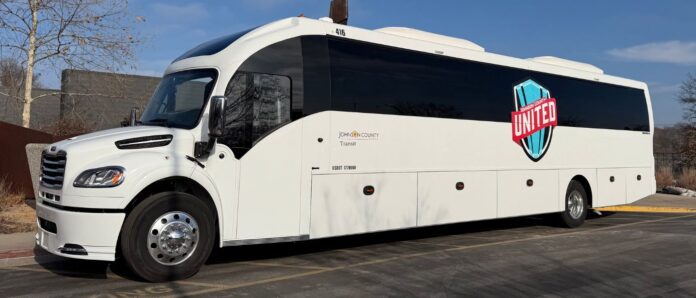
Johnson County’s transportation pilots launched for the 2026 World Cup cost an estimated $4.56 million, according to a county report released Nov. 18, offering a first look at spending and usage for the airport shuttle and a temporary bus network that included Olathe.
Airport Drop and Ride recorded 7,546 boardings at an estimated cost of $1,461,903. Johnson County Link, which connected destinations across seven cities, cost an estimated $3,096,941 and issued 6,557 passes.
The county reported contributing $61,085 toward the airport service and $137,162 toward Link. Grants and city partners funded the remainder. Those county contributions total $198,247, approximately 4.3% of the combined reported cost.
The services had different purposes and operating periods. The airport shuttle provided free transportation to Kansas City International Airport and continued beyond the tournament. Link offered paid circulator service connecting local destinations with the broader World Cup transportation network.
How Olathe fit into the system
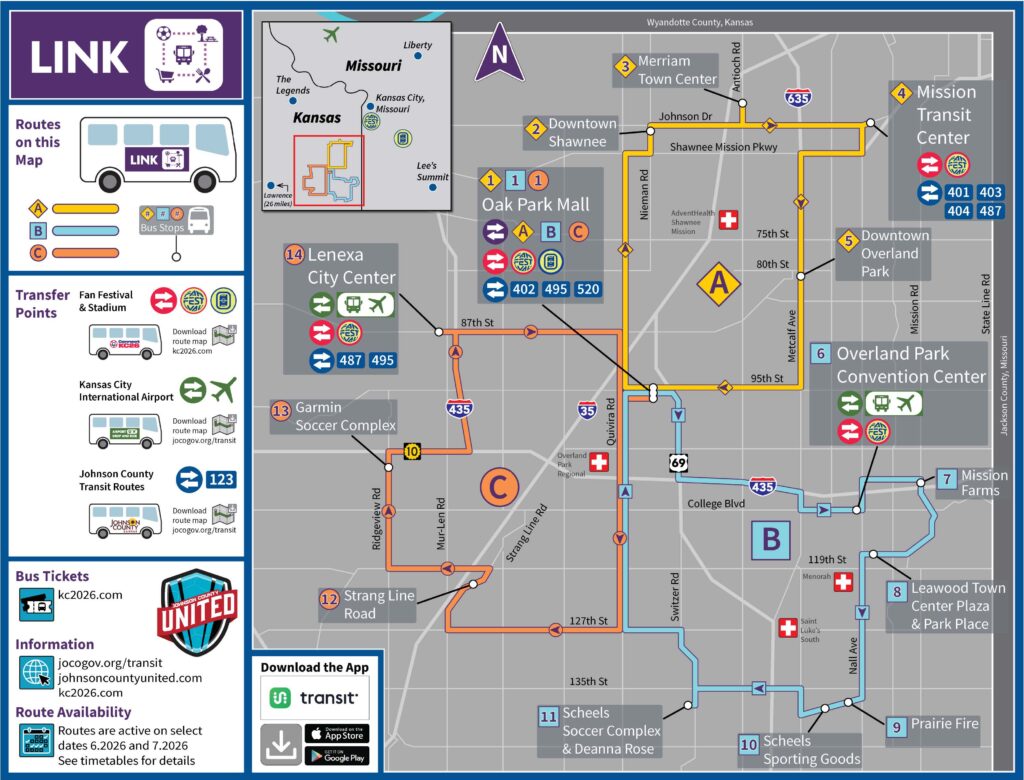
Link connected Olathe, Lenexa, Leawood, Merriam, Mission, Overland Park and Shawnee through three routes overlapping at Oak Park Mall.
Olathe’s March 17 council agenda materials identified two planned stops: along Strang Line Road south of 119th Street and along Ridgeview Road south of the Embassy Suites Hotel and Conference Center. The route also connected with Lenexa City Center and Oak Park Mall, where passengers could transfer to other services.
The city’s agreement called for a $111,486 contribution from transient guest tax revenue, generated by lodging stays. That was the amount requested in the agreement; the county’s November summary does not establish Olathe’s final expense.
Link operated from June 9 through July 13. Its published fares were $5 for a day pass, $25 for a seven-day pass and $50 for a tournament pass. Separate passes were required for the regional ConnectKC26 system serving the stadium and other destinations.
What the airport shuttle numbers mean
Airport Drop and Ride connected KCI with Lenexa City Center and the Overland Park Convention Center. It was available for general airport travel, rather than exclusively for World Cup visitors, and provided no long-term parking at its Johnson County stops.
Dividing its reported cost by its boardings produces an average of approximately $194 per boarding. That calculation spreads the entire reported service cost across recorded trips. It is not a fare, and a boarding is not necessarily a different person: someone riding to the airport and returning would account for two boardings.
The November report also found favorable passenger survey results. Among respondents, 96% rated the airport shuttle “excellent,” and 98% said they were very likely to recommend it. Link reported 82.8% on-time performance.
The airport shuttle ran every 30 minutes from June 1 through July 16, then shifted to hourly service July 17. It concluded Sept. 20.
In July, the county said maintaining half-hour service during the World Cup, increased diesel prices and higher-than-expected maintenance costs contributed to the September end date. Officials said the pilot was intended to operate until its limited funding was exhausted.
Original funding commitments were larger
The airport pilot’s original financing plan included a $2 million federal Congestion Mitigation and Air Quality Improvement Program grant. Johnson County, Lenexa and Overland Park each committed $200,000 in matching funds.
Those were funding commitments established for the pilot, rather than the final expenses now reported. The service was also intended to test demand for a longer-term public transportation connection between Johnson County and KCI.
For Link, the county initially outlined a $5.7 million funding plan: $920,000 from the county transit fund, approximately $2.9 million in existing federal transit grants, $400,000 from participating cities and $1.5 million in state transit funds.
The newly reported $3.1 million estimated cost is below that original plan. However, the November summary does not explain the difference or provide a final accounting of each funding source. The original agreement also called for fare proceeds to be distributed proportionally to the county and participating cities.
What remains unanswered
The figures provide a starting point for evaluating the pilots, but the two usage measures cannot be compared directly. Airport boardings count trips; Link passes could cover a day, a week or the tournament. Dividing Link’s cost by passes issued would therefore produce a cost per pass, not a cost per ride.
A fuller airport shuttle evaluation is expected before the Johnson County Transit Council and county commissioners in the first quarter of 2027. It is scheduled to examine operations, performance, market conditions, rider surveys and comparable airport transportation services.
That review should provide more evidence for assessing whether a future airport connection could attract enough riders at a sustainable cost. For Olathe residents, a final Link accounting would also help establish how the city’s planned contribution translated into local use.


 Something Different Media Group
