


City staff calls this the last renewal for quarrying at the Lone Elm site. Martin Marietta would agree to end blasting and rock crushing by Dec. 31, 2030, but reclamation and construction-debris landfilling could continue for roughly two more decades.
OLATHE, Kan. — One of Olathe’s longtime rock quarries could be entering its final four years of blasting under a permit renewal going before the Olathe Planning Commission Monday night, but activity at the property would continue long after the last rock is extracted.
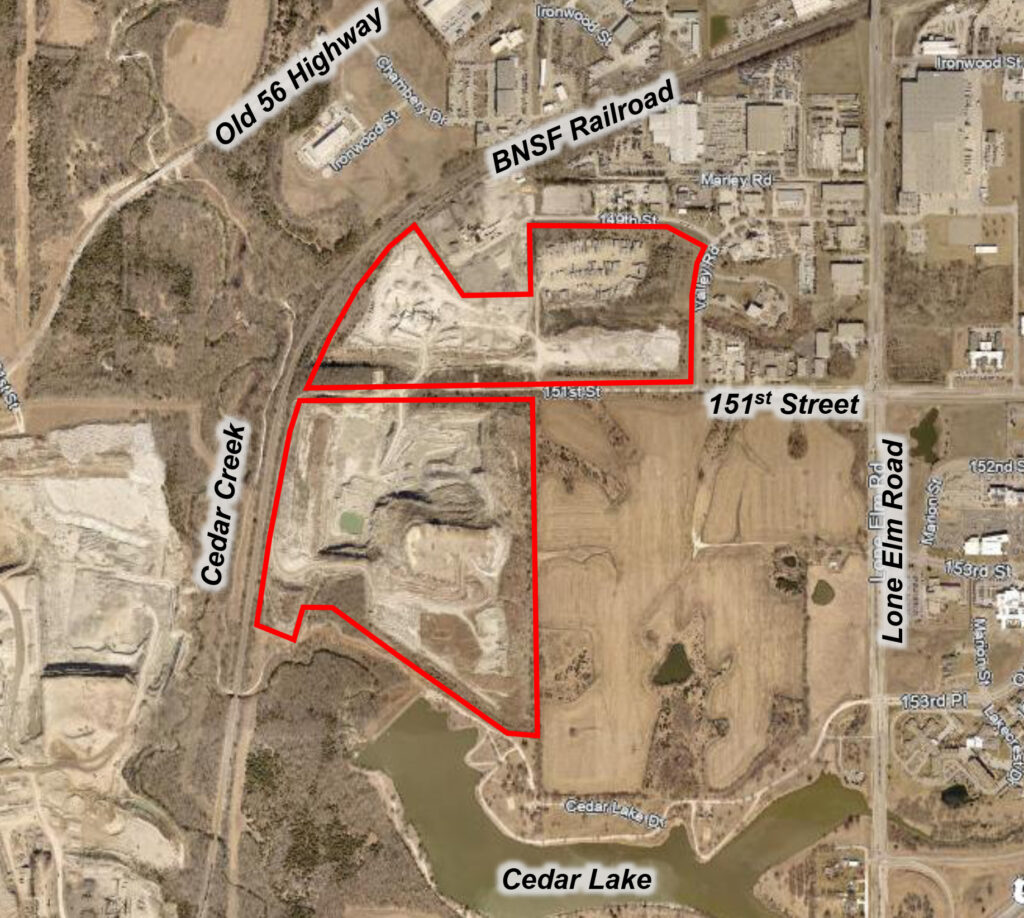
Martin Marietta is seeking a new special-use permit for the Lone Elm Quarry at 1600 W. 151st Street, a 175.72-acre operation on both sides of 151st Street west of Lone Elm Road. The company is asking to continue rock quarrying and crushing through the end of 2030, while retaining authority for a construction-and-demolition landfill that would be used to fill and reclaim the quarry over a much longer period.
City planning staff is recommending approval and describes the application as the last renewal for quarrying operations at the site. Martin Marietta says it expects to stop extracting rock and operating the crusher by Dec. 31, 2030. The company projects that filling and reclaiming the remaining quarry could continue through approximately 2046.
The hearing comes only weeks after another major quarry debate in Olathe, but the two projects should not be confused. The controversial Johnson County Aggregates expansion approved earlier this month is near 151st Street and Old 56 Highway. Monday’s hearing involves the separate Lone Elm Quarry operated by Martin Marietta farther east at 151st Street.
DUST AND ROCK ARE STILL REACHING 151ST STREET
One of the more significant findings in the city’s new staff report involves conditions outside the quarry itself.
City staff says rock spillage and accumulated dust from the property are still being found on 151st Street, prompting Martin Marietta to submit a more detailed dust-control plan as part of the renewal.
The proposed controls include a track-out system at the main entrance designed to remove dirt and loose material from truck tires, application of dust suppressant around heavily traveled areas four times a year, continued watering of haul roads and stockpiles, and vacuum sweeping of 151st Street at least once a week. Sweeping could increase to twice weekly depending on weather, seasonal conditions and activity at the quarry.
Outgoing trucks would have to be tarped before entering public roads, and the company says it would increase dust-control measures during dry or windy conditions.
Martin Marietta would also conduct more formal air-quality monitoring. The proposal calls for quarterly laboratory testing for asbestos, respirable crystalline silica, PM2.5 and PM10. Testing could eventually drop to once a year after four consecutive compliant samples. The company would also have employees trained in EPA visible-emissions monitoring on site when the crusher is operating.
A real-time air-quality monitor could also be deployed when requested by city staff.
ONE MAJOR DUST SOURCE WOULD NOT RECEIVE A SIGNIFICANT UPGRADE
The city report also identifies a notable limitation in the new dust-control plan.
The rock crusher itself — which staff describes as a major source of dust — would not receive significant new dust-suppression upgrades.
According to the staff report, Martin Marietta told the city those improvements may not be financially feasible given that the crusher is expected to operate for only about four more years. City staff says it is willing to accept that approach because the proposed permit would require crushing to end by Dec. 31, 2030.
Staff says air quality should improve significantly once crushing ends.
That tradeoff is one of the more important questions commissioners will consider Monday: whether stronger monitoring and controls during the quarry’s final years are sufficient without requiring a major investment in equipment that is scheduled to shut down in 2030.
BLASTING WOULD BE MORE RESTRICTED THAN UNDER THE OLD PERMIT
The proposed permit would also tighten blasting rules.
The 2022 permit allowed blasting as many as twice per day between 10 a.m. and 4:30 p.m. Monday through Friday.
Under the new conditions recommended by staff, blasting would be limited to one blast per day between 10 a.m. and 4 p.m. Monday through Friday, except when the Olathe fire marshal approves an exception because of a present danger, such as a partially failed blast or weather conditions after explosives have already been loaded.
Martin Marietta would also be required to offer an automated blast-notification service to property owners within 1,500 feet of the site. Blast records would have to be retained for at least three years and submitted electronically to the Olathe fire marshal within 48 hours of each blast.
City staff says it has received no blasting complaints involving this quarry since the 2022 permit was approved, and records submitted to the city show blasting has remained within applicable standards.
Blasting, crushing and the associated ground vibration would end permanently if the quarry closes in 2030 as proposed.
QUARRY WOULD CLOSE — BUT THE HOLE STILL HAS TO BE FILLED
Ending rock extraction does not mean the property will immediately become vacant.
The remaining quarry has to be reclaimed.
Martin Marietta’s plan calls for filling portions of the quarry over roughly 20 years, gradually bringing the property closer to the elevation of surrounding land. The reclamation plans show the fill progressing in roughly five-year stages through the 2030s and into the 2040s.
The company says the process ultimately involves placing shale and mining material in the quarry, adding intermediate cover and a final cap, and completing long-term monitoring under state requirements. Martin Marietta says the north portion of the property is ultimately intended for future industrial use, while the southern portion is expected to become green space.
The construction-and-demolition landfill is part of that reclamation process. Martin Marietta says it is not currently conducting C&D landfill activities but wants to retain the ability to do so in the future to help fill and reclaim the quarry under state-approved plans.
City staff supports allowing landfilling to continue for up to 20 years after final approval because the material would help fill the quarry and create a grade more consistent with surrounding property.
The permit would require landfilling to stop 20 years after approval by the Olathe City Council. Final capping and revegetation would then have to be completed under deadlines established by the city and state.
CITY SAYS DEVELOPMENT IS CLOSING IN ON THE QUARRY
The city’s position on the quarry has also changed as southwest Olathe develops around it.
The property is designated Parks and Open Space on Olathe’s long-range land-use map. While quarrying does not match that designation, city staff says the eventual reclamation of the southern portion of the site is consistent with the long-term vision.
Staff also points to several changes occurring nearby, including the Cedar Lake Trail extension, the West Cedar Creek Sewer Interceptor project and the recent annexation of 172 acres of agricultural property directly east of the quarry.
The staff report says the quarry remains generally compatible with surrounding industrial activity today, but that compatibility is decreasing as development and public activity move closer to the site.
That is part of the reason staff wants a firm ending date rather than another open-ended quarry approval.
CITY ACKNOWLEDGES THERE WOULD BE BENEFITS IF QUARRYING STOPPED NOW
In analyzing the permit, city staff makes an unusually direct acknowledgment of the environmental tradeoff.
Staff says denying the application would create a hardship for Martin Marietta because the company would have to close before extracting the remaining rock that was previously approved.
The quarry is also an economic contributor. Staff says it has supplied between 150,000 and 250,000 tons of rock annually to the local construction industry since 2022, providing nearby projects with a local source of aggregate and potentially reducing transportation costs.
But the city also acknowledges that immediately ending quarry operations would produce public-health and quality-of-life benefits.
“If the application were denied,” staff said, air quality would improve, vibration and noise from blasting would stop, and rock spillage from trucks leaving the facility would no longer occur.
Staff ultimately concludes that allowing Martin Marietta to extract the remaining rock through 2030 — under tighter conditions and with a firm shutdown date — strikes a reasonable balance.
NEW PUBLIC OVERSIGHT WOULD BE REQUIRED
The proposed permit would also create several transparency requirements that were not included in the previous approval.
Martin Marietta would have to establish a formal system for members of the public to submit complaints. The company would maintain a complaint log showing complaints and responses and make that information available to the city and regulatory agencies when requested.
The company would also submit an annual compliance report covering issues including blasting, air quality and whether the dust-control plan is working. City staff could meet annually with Martin Marietta to discuss the report and require operational changes when necessary.
Five years after approval — which would be roughly one year after crushing is scheduled to stop — a compliance report would be presented to the City Council. The council could require additional reviews after that.
The current proposal would allow general operations between 6 a.m. and 6 p.m. Monday through Saturday. The previous 2022 permit generally allowed operations from 7 a.m. to 6 p.m., meaning the proposed conditions appear to allow general activity to begin an hour earlier.
A 2025 PIPE FAILURE CAUSED FLOODING
The packet also documents one infrastructure problem since the previous permit was approved.
A private stormwater pipe failed on the quarry property in 2025, causing upstream stormwater to flood Valley Road and damage off-site infrastructure, including a nearby city sewer lift station.
The operator replaced the failed pipe, and staff says there have been no other stormwater complaints or incidents involving the property since then.
The quarry has also passed state landfill inspections and annual air-quality inspections of its rock-crushing equipment, according to the city.
NO ORGANIZED NEIGHBORHOOD OPPOSITION SO FAR
Unlike the recent Johnson County Aggregates quarry case, this application has not generated a large organized neighborhood response.
The city required notification of surrounding property owners, but no residential properties are located within 500 feet of the site, so a neighborhood meeting was not required.
As of the staff report, the city had received no public correspondence opposing or supporting the application.
That does not prevent residents from speaking at Monday night’s public hearing.
The Planning Commission will consider the application at 7 p.m. Monday, Oct. 26, at Olathe City Hall, 100 E. Santa Fe St. The commission will make a recommendation; final approval of the special-use permit rests with the Olathe City Council.
If ultimately approved, the permit would put a specific expiration date on an industrial operation that has been part of this area of Olathe for decades: blasting and crushing would end in 2030, while the much slower job of filling, capping and reclaiming the quarry could continue well into the 2040s.


 Something Different Media Group
