

Olathe directed approximately $17.85 million from its street maintenance sales tax fund to 16 project accounts in 2025, paying toward neighborhood resurfacing, major-road repairs, curb replacement and work replacing a gravel stretch of 167th Street.
An oversight committee reviewing the spending concluded the money was used consistently with the purpose voters approved. Committee member Gene Senesac presented the findings to the City Council on Tuesday, Nov. 17.
The report also shows the fund drew on its existing balance as project transfers exceeded annual revenue, ending 2025 with just under $1 million remaining.
“The committee believes that the revenues were spent in accordance with the sales tax referendum,” Senesac told council members.
What came in — and what went out
The annual report lists $17,195,599 in total revenue for 2025: $16,982,331 in sales tax collections and $213,268 in interest income.
Transfers to street preservation projects totaled $17,848,046.
The $652,447 difference came from the fund’s existing balance. That balance fell from $1,650,827 at the beginning of 2025 to $998,380 at year’s end.
Those transfers represent money directed to project accounts. The report includes projects completed in 2025 as well as allocations for later-year work.
Where the money went
The largest allocation was approximately $4.49 million for one group of local and collector street resurfacing projects. A second group received approximately $3.31 million.
Together, those two allocations accounted for nearly $7.8 million of the street-tax funding.
The report’s allocation table lists the following amounts. These are the 2025 street maintenance sales tax contributions, not necessarily each project’s total cost. Some projects also received money from other sources.
| Project or program account | 2025 street-tax allocation |
|---|---|
| Local and collector street resurfacing — Group A | $4,490,396.97 |
| Local and collector street resurfacing — Group B | $3,305,257.49 |
| 135th Street mill and overlay | $2,839,756.30 |
| 143rd Street mill and overlay | $1,578,332.65 |
| Clare Road mill and overlay | $1,174,142.35 |
| K-7 Highway mill and overlay | $1,146,834.11 |
| 167th Street improvements | $837,204.34 |
| Microsurfacing | $681,180.24 |
| Curb replacement | $457,875.44 |
| Kansas Avenue mill and overlay | $255,000.00 |
| Old 56 Highway mill and overlay | $240,000.00 |
| 119th Street mill and overlay | $200,000.00 |
| Lakeshore Drive mill and overlay | $186,352.73 |
| Street Preservation Program support and programwide work | $185,474.38 |
| Cedar Lake Drive improvements | $185,000.00 |
| Crack sealing | $85,239.00 |
| Total | $17,848,046.00 |
The programwide account covers costs such as staff time not assigned to individual projects, training, software, equipment, testing and work not associated with another project.
The report also includes a Valley Parkway resurfacing project completed in 2025. Its funding came from earlier street preservation programs, so it received no allocation from the 2025 street-tax column shown above.
What residents got on the ground
The two local and collector resurfacing groups covered 101 street locations and 32.8 lane-miles, according to the report. The work included new asphalt surfaces, spot curb and sidewalk replacement, accessible sidewalk ramps and pavement markings.
The broader preservation program also completed microsurfacing on 181 local and collector streets, totaling 56.8 lane-miles. That project used both street-tax money and general obligation bonds.
Other results included 19,222 linear feet of curb replacement and crack-sealing work covering 174 lane-miles, along with 1,686 individual wide-crack patches.
On 143rd Street between Mur-Len and Black Bob roads, the project included resurfacing, drainage work, sidewalk and ramp improvements, a shared-use path and a flashing pedestrian crossing beacon at Blackfeather Street.
The allocations also helped fund work on K-7, Lakeshore Drive and Clare Road, and designated money for later projects on 135th Street, Old 56 Highway, Kansas Avenue, 119th Street and Cedar Lake Drive.
A gravel road becomes pavement
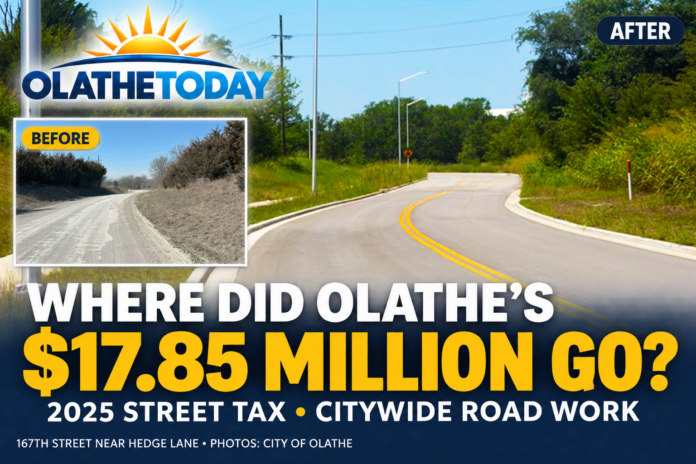
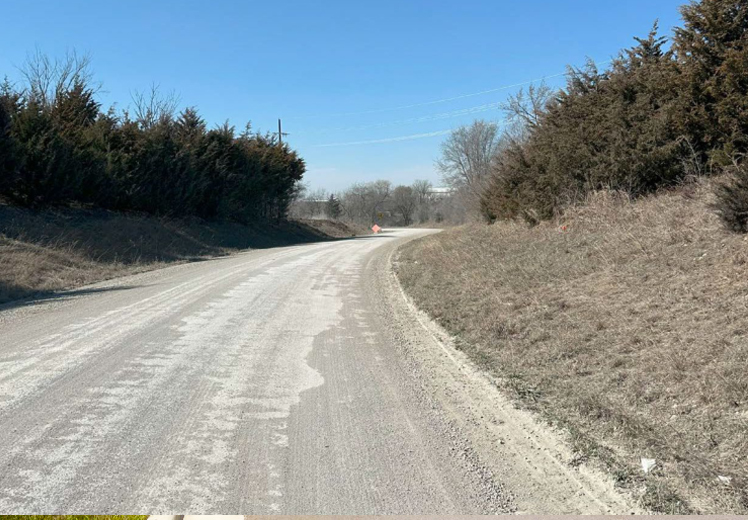
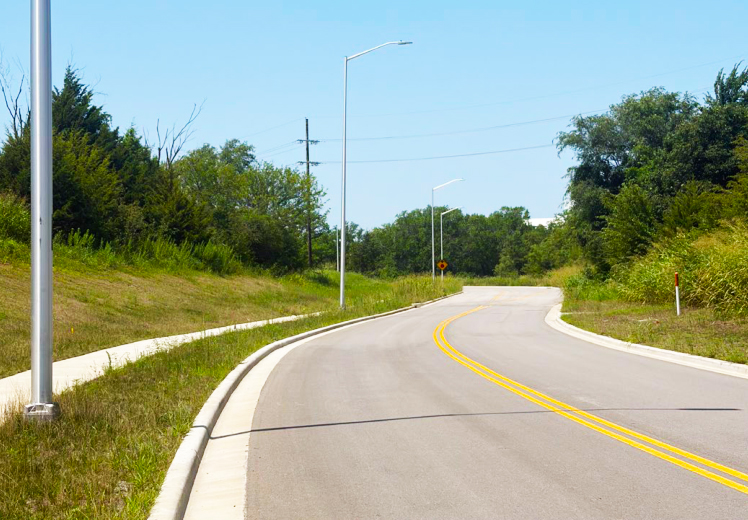
One of the report’s clearest before-and-after examples is 167th Street near Hedge Lane.
That project replaced an existing gravel road with asphalt pavement, curb and gutter. It also added sidewalk, streetlighting, guardrail, drainage improvements and pavement markings.
The project received approximately $837,204 from the 2025 street-tax fund, with additional funding from the previous year’s preservation program.
Senesac said the committee’s discussion included Olathe’s remaining gravel roads, with “three lane miles left in the city of Olathe.”
Lane-miles measure each lane separately. A mile of road with two lanes counts as two lane-miles.
Oversight, not project selection
The seven-member committee reviews street-tax income and expenditures and reports whether spending follows the voter-approved referendum. It does not select projects, define their scope or direct city staff.
Senesac said members met Oct. 12 to review the finances, discuss project timing and walk through the work included in the report.
He singled out the project photographs as especially helpful.
“There’s before and afters, which I found to be most useful,” he said.
Councilmember Dean Vakas thanked members for questioning staff about the projects and their funding.
“We challenge you to ask questions of city staff to better understand what those road projects are, how they come together,” Vakas said.
Voter-approved tax runs through 2034
Olathe voters first approved the 0.375% street maintenance sales tax in 2013. Collections began in April 2014.
Voters renewed it in April 2023, extending collections from April 2024 through March 2034.
The tax is dedicated to repairing, rebuilding, rehabilitating, upgrading and improving city streets.
Mayor John Bacon thanked voters for supporting that source of funding.
“Otherwise, we wouldn’t have this money coming in to do all these projects,” Bacon said.


 Something Different Media Group
