

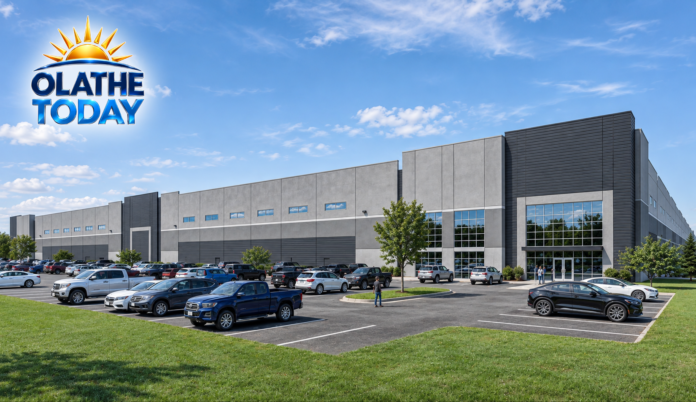
A developer is asking Olathe for an 80% property-tax break lasting a decade to build a million-square-foot warehouse near 175th Street and U.S. 169.
The proposal comes with a forecast of 711 new jobs over 10 years. But the building is speculative, and its eventual occupants are not identified in the application.
Scannell Properties is seeking up to $80,465,680 in industrial revenue bonds for the project. The council received a report Nov. 3 without approving the incentives. A public hearing and consideration of a resolution of intent are scheduled for Nov. 17.
The request advances Frontier Trails Logistics, a warehouse and distribution project northwest of the intersection. The council approved its rezoning Oct. 6. That land-use approval allowed the development to proceed through the planning process; the financial incentives require a separate decision.
The financing application describes a 1,006,880-square-foot building on approximately 70.49 acres. That is more than 23 acres of floor space inside one facility.
The proposed bond amount includes approximately $5.07 million for land and $75.4 million for construction.
Industrial revenue bonds do not make that entire amount a city expenditure. Under the draft resolution, the bonds would be repaid solely from project-related lease revenues and would not become general obligations of Olathe. The company would also be responsible for issuance costs.
The public assistance at issue is the proposed tax treatment.
The draft resolution would seek a property-tax exemption for eligible bond-financed property while requiring payments equivalent to approximately 20% of otherwise applicable taxes for 10 years. That produces the requested 80% abatement. The school district’s capital-outlay levy, which cannot be abated under state law, would remain payable.
Those terms appear in the draft resolution included in the council packet.
Staff estimates Olathe would receive approximately $70,000 annually in property-tax revenue during the abatement, compared with approximately $350,000 annually after it expires. The report lists current city property-tax revenue from the site as $0. Those figures are estimates, dependent on future valuation and development.
Olathe’s incentive policy generally starts with a 50% abatement and allows qualifying warehouse, distribution, logistics, manufacturing and data-center projects in a designated area to receive up to 80%. Staff says the Scannell site falls within that area.
The policy calls for projects to have a positive financial impact on the city and considers investment, employment and other community benefits.
The employment forecast assumes 675 jobs in the first operating year and four additional jobs annually for the following nine years. Projected average annual salaries start at $48,000 and rise to $74,464 in year 10.
Those are assumptions supplied for evaluating the incentive request. The application says Scannell would occupy none of the building and other occupants would use all of it, but leaves the space for identifying those occupants blank.
The city’s financial analysis also deserves a closer reading than its headline ratio provides.
The cost-benefit report lists Olathe’s ratio as 0.90 and puts the discounted payback period for incentives beyond 10 years.
Yet the same report projects approximately $9.56 million in city benefits and $5.79 million in costs, incentives and taxes abated — leaving a positive net benefit of about $3.77 million before discounting future dollars.
It’s present-value columns show approximately $2.34 million in net benefits and $2.60 million in incentives and taxes abated. Dividing those two figures produces approximately 0.90.
That comparison uses net benefits, rather than total benefits. However, the report’s generic explanatory page describes its ratio as a comparison of public benefits with public costs. The published materials therefore need clarification about how the reported ratio should be interpreted alongside the positive net-benefit forecast.
A ratio below 1.0 should not, by itself, be presented as proof that this report forecasts an overall city loss.
The project is located in the Spring Hill School District. The financial model also evaluates effects on that district, Johnson County, Johnson County Community College and the state, including assumptions about new residents and students.
A performance agreement would be required if the tax abatement proceeds. Olathe’s policy provides for reducing abatements when required capital investment is not made and allows reductions or elimination for certain failures to comply with the agreement.
The Nov. 17 hearing will bring the incentive request before the council for consideration. Even if a resolution of intent passes, the draft requires a later ordinance authorizing bond issuance and agreement on the financing documents before the bonds can be issued.


 Something Different Media Group
