

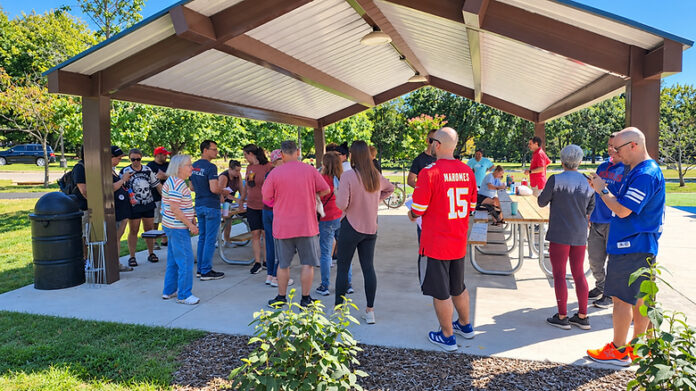
Olathe Families United has raised its collection goal to 8,200 signatures after finding errors in roughly 20% of those reviewed. A successful petition would force a state review and another Olathe school board hearing — but it would not automatically reverse the closures.
OLATHE, Kan. — The campaign challenging Olathe Public Schools’ decision to close six schools has now collected more signatures than the number organizers originally believed they needed.
But the fight is far from over.
Olathe Families United reported Sunday, Nov. 1, that its “6,100 Voices” campaign had collected 6,322 signatures from registered voters living within the Olathe school district.
The group says 6,115 valid signatures are required to trigger an administrative review by the Kansas State Board of Education. Because volunteers are finding errors in approximately 20% of signatures reviewed, however, organizers have raised their collection goal to 8,200.
That means the campaign is now looking for another 1,878 signatures by Nov. 10.
“We’ve reached 6,322 reported signatures,” Olathe Families United said in announcing the new goal. “Reaching the required number on paper isn’t enough. We need enough signatures to qualify after review.”
The group said it has spoken with the State Board of Education’s office and was told the office will turn the petition sheets in for verification on the campaign’s behalf. Organizers are asking circulators to return completed sheets before Nov. 10 so volunteers have time to review them for potential problems.
WHY 6,322 SIGNATURES MAY NOT BE ENOUGH
Kansas law requires signatures from at least 5% of the registered voters in the school district to request a state review of a school-closing resolution.
For Olathe, organizers say that number has been calculated at 6,115 valid signatures.
The distinction between signatures collected and signatures accepted is now critical.
If approximately 20% of the signatures ultimately fail verification, 6,322 collected signatures would produce only about 5,058 valid signatures — more than 1,000 short of the threshold.
At that same 20% rate, organizers would need approximately 7,644 collected signatures just to reach 6,115 valid signatures.
Their new 8,200-signature goal would provide additional breathing room. If 20% were rejected, approximately 6,560 would remain valid — about 445 more than required.
Those numbers are only an illustration because the final rejection rate could be higher or lower than the percentage volunteers are currently finding.
WHAT HAPPENS IF THEY GET ENOUGH?
Reaching the threshold would not overturn the Olathe Board of Education’s Oct. 1 decision.
It would, however, trigger a process that Olathe families have not had before.
Under K.S.A. 72-1431, the Kansas State Board of Education must conduct an administrative review when a valid request signed by at least 5% of registered voters is received within 45 days of a local school board’s closure resolution.
The State Board would examine whether Olathe’s decision was “reasonable under the totality of the circumstances.”
It then has up to 45 days to issue an advisory determination. The state could determine that Olathe’s decision was reasonable, or it could recommend modifying or rescinding the closure resolution.
Whatever the State Board decides, Olathe’s Board of Education would then be required to reconsider the closure resolution and hold another public hearing.
After that hearing, the Olathe board could approve the original closure plan again, modify it or rescind it.
That means the petition gives families another hearing and another vote — not a veto over the existing decision.
COULD THE BOARD SAVE SOME SCHOOLS WITHOUT SAVING ALL SIX?
Yes.
That may be one of the most important parts of the state-review process.
The law does not limit the Olathe board to choosing between closing all six schools or keeping all six open. Following the state review, the local board can “modify and approve” its resolution.
That could theoretically allow the board to change the number of schools closing, delay one or more closures, phase the closures over a longer period or otherwise rewrite the original resolution.
There is no indication at this point that the Olathe board intends to do that.
But legally, the door would be open.
SO WHAT ARE THE FAMILIES’ CHANCES?
There are really two different questions.
The first is whether Olathe Families United can collect enough valid signatures to force a state review.
Based on its reported progress, that goal appears attainable. The campaign has already collected 6,322 signatures and still has several days before its Nov. 10 collection deadline. The larger challenge is making sure enough of those signatures survive verification.
The second question — whether the process ultimately keeps any of the six schools open — is considerably more difficult.
The Olathe Board of Education voted 7-0 on Oct. 1 to close Black Bob, Heritage, Scarborough, Tomahawk and Walnut Grove elementary schools and Indian Trail Middle School following the 2026-27 school year.
A unanimous vote does not prevent board members from changing their minds, but it means opponents would need to persuade at least four members to support a different outcome when the issue returns.
There is also recent Kansas precedent working against those seeking a reversal.
According to the Kansas Department of Education, the state-review provision has been used three times this year for closures involving Logan Avenue Elementary in Emporia, Wilson Elementary in Wilson and Greeley Elementary in Garnett.
In all three cases, the Kansas State Board of Education determined the local school-closing decisions were reasonable.
Olathe’s case could be different, but so far the state review process has not produced a recommendation overturning a school closure.
THE $12 MILLION QUESTION
Families seeking to change the board’s mind also face the financial case the district has built for consolidation.
Olathe Public Schools says closing the five elementary schools and Indian Trail Middle School will save more than $12 million annually.
The district’s published breakdown includes approximately $8 million in staffing compensation and benefits achieved through attrition and retirements, $2.5 million in avoided building infrastructure and system costs, $960,000 in building operations, $460,000 in technology costs and $80,000 in maintenance and grounds expenses.
The district says enrollment has declined by roughly 2,650 students since the 2019-20 school year and has argued that it is operating more buildings than its current elementary enrollment requires. District officials have also pointed to special-education funding pressures and depleted reserves as reasons the current system cannot continue unchanged.
That means opponents likely need to do more than argue that the closures are disruptive.
To substantially change the board’s position, they would have a stronger case if they can identify recurring revenue, reimbursements, cost reductions or a different consolidation strategy that addresses a meaningful portion of the district’s projected savings while also answering the district’s concerns about underused buildings.
Even before the Oct. 1 vote, Superintendent Brent Yeager told organizers the district was willing to hear alternative solutions, while also cautioning that financial alternatives would not necessarily solve the district’s facility-utilization issues.
BOUNDARY PROCESS IS MOVING FORWARD
While the petition campaign continues, the district is not standing still.
Olathe Public Schools is already working on new attendance boundaries for the 2027-28 school year. Community meetings are taking place this fall, with district leaders expected to present boundary recommendations later this year and the Board of Education expected to establish new boundaries by January 2027.
Those changes will affect not only students attending the six schools scheduled to close but also families at schools that remain open.
The district has also begun planning student and staff transitions.
That creates a shrinking window for any major change. The farther the district progresses into boundary changes, staffing plans and transition work, the more complicated it could become to unwind all or part of the closure decision.
PETITION COULD PUSH DECISION INTO ANOTHER ROUND
For now, Olathe Families United’s immediate challenge is mathematical rather than political.
It needs 6,115 valid signatures.
It has 6,322 reported signatures.
And because organizers are discovering potential problems with a significant percentage of signatures, they now want 8,200 before turning the petition over for verification.
If they reach that goal and enough signatures are accepted, Olathe’s six-school closure decision would move into a process that could extend well into December — potentially overlapping with the district’s work on new boundaries.
What happens after that would depend on two groups: the Kansas State Board of Education, which would decide whether Olathe’s original decision was reasonable, and ultimately the same Olathe Board of Education that voted unanimously for the closures in October.
The petition can force another look.
Whether that second look changes the future of Black Bob, Heritage, Scarborough, Tomahawk, Walnut Grove or Indian Trail remains an open question.
Registered voters who live within the Olathe School District can still sign the petition in person. Olathe Families United is continuing to hold signing opportunities through Nov. 10 as it works toward its new goal of 8,200 signatures. The group says additional locations are being added regularly, and voters can find the latest signing times and locations at OlatheFamiliesUnited.org.


 Something Different Media Group
